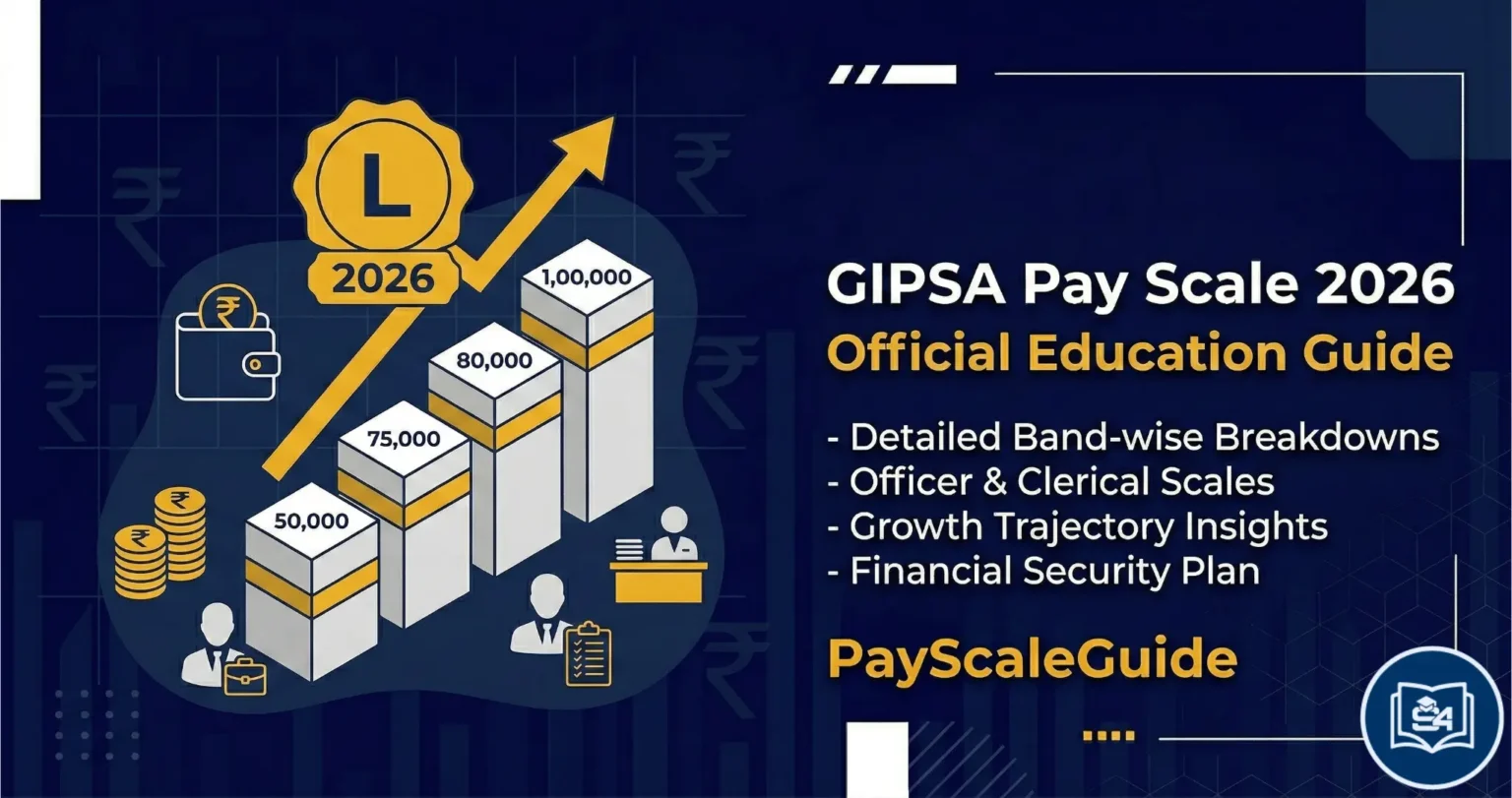
GIPSA Pay Scale 2026: Revised Salary, In-Hand Pay & Allowances for Officers, Development Officers and Clerical Staff

If you are preparing for NIACL AO, NICL AO, OICL AO or UIICL AO, one of the first questions on your mind is — how much will I actually earn after selection?

The Central Government has officially notified a comprehensive wage revision for all Public Sector General Insurance Companies (PSGICs) through the Gazette of India dated 11 February 2026 (S.O. 716–719(E)). This is the 18th Schedule Pay Revision, effective retrospectively from 1 August 2022.

This post gives you every number — basic pay, in-hand salary, HRA, CCA, NPS, allowances, and arrears — directly from the official gazette notification.


Quick Facts at a Glance

DetailValue
Scale I Entry Basic Pay₹82,485/month
Scale I In-Hand Salary (Metro)~₹1.05–1.10 lakh/month (estimated)
NPS Employer Contribution (Revised)14% of Basic + DA (was 10%)
Effective Date1 August 2022 (retrospective)
Arrears Period~42 months
Gazette Published11 February 2026
AuthorityMinistry of Finance — S.O. 716–719(E)

Table of Contents

  1. Companies Covered Under GIPSA
  2. Officer Pay Scale — Scale I to VII (18th Schedule)
  3. In-Hand Salary Estimate — Scale I Officer
  4. HRA, CCA, Transport and Other Allowances
  5. Development Officer Salary — Schedule K
  6. Assistant / Clerk / Subordinate Staff Salary
  7. NPS and Family Pension — What Changed?
  8. Arrears — Who Gets What?
  9. Promotion Path and Salary Growth
  10. Frequently Asked Questions

1. Companies Covered Under GIPSA

GIPSA stands for General Insurance Public Sector Association. The 2026 wage revision applies to all GIPSA member companies. If you are appearing for any of the exams listed below, this is your salary structure:

CompanyShort NameExam
New India Assurance Company Ltd.NIACLNIACL AO, NIACL Assistant
National Insurance Company Ltd.NICLNICL AO, NICL Assistant
Oriental Insurance Company Ltd.OICLOICL AO, OICL Assistant
United India Insurance Company Ltd.UIICLUIICL AO, UIICL Assistant
General Insurance Corporation of IndiaGIC ReGIC Scale Officer
Agriculture Insurance Company of India Ltd.AICILAICIL Officer
Note: All GIPSA companies follow the same pay scales notified by the Ministry of Finance. Whether you join NIACL in Mumbai or UIICL in Chennai, your basic pay, HRA, CCA and all allowances are identical.

2. Officer Pay Scale 2026 — Scale I to VII (18th Schedule)

Officers are Class I employees. You join as an Administrative Officer (Scale I) after clearing the GIPSA recruitment exam and progress up to General Manager (Scale VII). The 18th Schedule is the most significant pay revision since 2017.

ScaleDesignationStarting Basic Pay (₹)Increment StructureMaximum Basic Pay (₹)
Scale IAdministrative Officer (AO)82,485₹4,050 × 14 steps + ₹4,390 × 4 steps1,56,745
Scale IISr. Administrative Officer1,10,835₹4,050 × 7 + ₹4,390 × 61,65,525
Scale IIIAssistant Manager1,35,135₹4,050 × 1 + ₹4,390 × 6 + ₹5,785 × 41,88,665
Scale IVDeputy Manager1,65,525₹5,785 × 92,17,590
Scale VManager / AGM2,00,235₹5,785 × 3 + ₹6,515 × 62,56,680
Scale VIDeputy General Manager2,24,105₹6,755 × 82,78,145
Scale VIIGeneral Manager2,51,125₹6,755 × 2 + ₹7,240 × 1 + ₹7,920 × 1 + ₹8,215 × 43,12,655
How big is this increase? The Scale I entry basic pay has jumped from ₹50,925 (old 16th Schedule) to ₹82,485 — a ~62% increase. Since DA, HRA, CCA and FPA are calculated as percentages of basic pay, the total emolument increase is even higher.

3. In-Hand Salary Estimate — Scale I Officer

Your take-home salary depends on your city of posting, DA rate (revised every quarter), and deductions. Below is a realistic monthly estimate for a freshly joined Scale I AO at basic pay ₹82,485:

ComponentMetro CityA-Class CityOther Cities
Basic Pay₹82,485₹82,485₹82,485
Dearness Allowance (~55%+)~₹45,000+~₹45,000+~₹45,000+
HRA₹8,250 (10%)₹6,600 (8%)₹5,774 (7%)
CCA₹2,475 (3%)₹2,062 (2.5%)Nil
Transport Allowance₹3,300₹3,300₹3,300
Fixed Personal Allowance (FPA)₹4,390₹4,390₹4,390
Less: NPS (employee share 10%)~₹8,200~₹8,200~₹8,200
Estimated Gross Monthly~₹1,08,000~₹1,03,000~₹97,000
Note: DA is revised quarterly based on AICPI (All India Consumer Price Index). Actual take-home will also depend on income tax slab and any loan deductions. Annual CTC including NPS, gratuity and medical benefits is significantly higher than the monthly gross figure.

4. HRA, CCA, Transport and Other Allowances — Officers

House Rent Allowance (HRA) — w.e.f. 1 August 2022

City CategoryExamplesHRA RateMaximum (₹/month)
Metro / Tier-1Mumbai, Delhi, Kolkata, Chennai, Bengaluru, Hyderabad, Pune, Ahmedabad, Faridabad, Ghaziabad, Noida, Gurgaon10% of Pay₹13,000
Cities with pop. >12 lakh + all of GoaExcluding metros listed above8% of Pay₹11,000
All Other PlacesRemaining cities and towns7% of Pay₹10,500

City Compensatory Allowance (CCA) — w.e.f. 1 August 2022

ClassCitiesRateMax (₹/month)
MetroSame 13 metro cities as HRA above3% of Pay₹3,300
A ClassPop. >12 lakh (excl. metro) + all Goa cities2.5% of Pay₹3,100
B ClassPop. 5–12 lakh; State capitals (pop. ≤12L); Chandigarh, Mohali, Panchkula, Pondicherry, Port Blair2% of Pay₹2,400
C ClassAll other citiesNIL

Fixed Personal Allowance (FPA) — Scale-wise

ScaleFPA (₹/month)Counts as Basic Pay for
Scale I & II₹4,390HRA, PF, Pension, Gratuity, Leave Encashment
Scale III & IV₹5,785Same as above
Scale V₹6,515Same as above
Scale VI₹6,755Same as above
Scale VII₹8,215Same as above

Other Allowances — Summary

AllowanceAmountKey Condition
Transport Allowance₹3,300/monthFor officers not covered under any conveyance reimbursement scheme
Hill Station Allow. (altitude ≥1,500m)2.5% of Pay, max ₹2,055/monthPayable from month following gazette / date of posting to hill station
Hill Station Allow. (1,000–1,500m)2% of Pay, max ₹1,650/monthAlso for Mercara and other declared hill stations
Kit Allowance (one-time, hill posting)₹14,800Not payable if already drawn; not payable on hill-to-hill transfer
Paradeep Port Allowance₹440/monthOnly for confirmed officers posted at Paradeep Port office. Does NOT count as Basic Pay.
Exam Tip: FPA (Fixed Personal Allowance) counts as Basic Pay for HRA, Provident Fund, Pension, Gratuity and Leave Encashment — this distinction is frequently tested in GIPSA internal promotion exams and IC-series papers. Paradeep Port Allowance does NOT count as Basic Pay for any purpose.

5. Development Officer Salary 2026 — Schedule K

Development Officers (DOs) are Class II field officers. Their pay scales have been revised under the new Schedule K:

GradeStarting Basic Pay (₹)Increment StructureMaximum Basic Pay (₹)
DO Grade I₹58,010₹3,640×8 + ₹3,770×9 + ₹3,945×2 + ₹4,050×4₹1,45,150
DO Grade II₹39,385₹2,600×3 + ₹2,960×4₹59,025

DO Allowance Caps

AllowanceMetroA ClassB Class
HRA10%, max ₹13,0008%, max ₹11,0007%, max ₹10,500
CCA3%, max ₹2,8002.5%, max ₹2,6002%, max ₹2,300
FPA — Grade I₹4,050/month (counts as Basic Pay for HRA, PF, Pension)
FPA — Grade II₹2,960/month
Special Arrear Rule for DOs: Full arrears are payable from 1 April 2023 only. For the period 1 August 2022 – 31 March 2023, DOs receive an “Equitable Relief” (the difference between old and new gross emoluments, with consequential adjustment of PF, Pension, Gratuity and Leave Encashment). This is unique to the Development Officer cadre.

6. Assistant / Clerk / Subordinate Staff Salary 2026 — 12th Schedule

Class III (Supervisory and Clerical) and Class IV (Subordinate Staff) employees now get the 4th Rationalised Pay Scales under the 12th Schedule:

PostStarting Basic Pay (₹)Maximum Basic Pay (₹)
Senior Assistant / Stenographer₹50,815₹1,26,125 (+stagnation up to ₹1,50,425)
Assistant, Typist, Telephone Operator, Receptionist, etc.₹36,290₹1,00,865 (+stagnation up to ₹1,29,215)
Record Clerk₹33,670₹90,570
Driver₹33,670₹78,060
Other Subordinate Staff₹29,320₹67,095

Key Allowance Differences — Clerical vs Officers

AllowanceOfficersClerical / Subordinate Staff
Transport Allowance₹3,300/month₹1,200/month
CCA Metro Cap₹3,300/month₹2,600/month
Kit Allowance (hill posting)₹14,800 (one-time)₹3,700 (once in 3 years)
FPA — Sr. Asst / Steno / Asst₹4,050/month
FPA — Record Clerk₹2,560/month
FPA — Driver / Subordinate Staff₹1,880/month

7. NPS and Family Pension — What Changed?

NPS Employer Contribution — Revised Upward

ContributionOld RateNew Rate (w.e.f. 1 Aug 2022)
Employer (Company) → NPS10% of Basic + DA14% of Basic + DA
Employee → NPS10% of Basic + DA10% of Basic + DA (unchanged)
For a Scale I officer with basic pay ₹82,485 and DA ~55%, the monthly basic+DA is ~₹1.28 lakh. Employer NPS contribution rises from ₹12,800 to ₹17,920 per month — an extra ₹5,120/month or ₹61,440/year going into your retirement corpus.

Family Pension — New Formula (S.O. 719)

ComponentRateMinimum
Basic Family Pension30% of Pay₹375/month (category a)
Additional Family Pension30% of PF-counted allowances (excluding DA)₹720/month (cat. b); ₹1,100/month (cat. c)

8. Arrears — Who Gets What?

Since the revision is retrospective from 1 August 2022, employees will receive the difference between old and new salary for all past months:

Your StatusArrears Entitlement
✅ Currently serving (as on gazette date)Full arrears from 1 Aug 2022 (or date of joining, whichever is later)
✅ Retired after 1 Aug 2022Arrears up to date of retirement + difference in gratuity amount
✅ Died in service after 1 Aug 2022Arrears to PF nominee up to date of death + gratuity difference to gratuity nominee
📋 Development Officers (serving)Arrears from 1 Apr 2023 + Equitable Relief for Aug 2022 – Mar 2023
⏳ Opted for a later start dateArrears only from chosen date (no arrears for prior period)
❌ Resigned or terminated between 1 Aug 2022 and gazette dateNOT ELIGIBLE for arrears
30-Day Option Window: Employees who want to choose a specific date for revised pay fixation (between 1 Aug 2022 and the gazette date) must submit written intimation to their Corporation/Company within 30 days of gazette publication. No arrears will be payable before the chosen date.

9. Promotion Path and Salary Growth

StageDesignationScaleMin. Basic Pay (₹)Approx. Timeline
EntryAdministrative Officer (AO)Scale I₹82,485On joining
L2Senior Administrative OfficerScale II₹1,10,835~3–5 years
L3Assistant ManagerScale III₹1,35,135~8–10 years
L4Deputy ManagerScale IV₹1,65,525~12–15 years
L5Manager / AGMScale V₹2,00,235~18–20 years
L6Deputy General ManagerScale VI₹2,24,105~22–25 years
L7General ManagerScale VII₹2,51,125Senior cadre

Promotions are through Annual Performance Appraisal (APAR), internal departmental exams and seniority. Each scale jump also raises DA, HRA, CCA and FPA — making total emoluments grow substantially at every promotion.


10. Frequently Asked Questions (FAQs)

Q1: What is the in-hand salary of a GIPSA Scale I AO after the 2026 revision?

After the 18th Schedule revision, a freshly joined Scale I AO earns approximately ₹1.05–1.10 lakh gross per month in metro cities. After NPS deduction (~₹8,200), the estimated take-home is around ₹95,000–1,00,000. In non-metro cities it ranges from ₹88,000–95,000. Exact amount depends on DA rate and income tax slab.

Q2: Is the 2026 revision applicable to NIACL, NICL, OICL and UIICL?

Yes. The gazette notification S.O. 716–719(E) dated 11 Feb 2026 applies to all GIPSA companies — NIACL, NICL, OICL, UIICL, GIC Re and AICIL. All these companies follow identical pay scales notified by the Ministry of Finance under the General Insurance Business (Nationalisation) Act, 1972.

Q3: How much arrears will current employees receive?

Arrears cover approximately 42 months (1 August 2022 to implementation date). For a Scale I officer, the monthly difference between old and new salary is significant, and the total lump-sum arrear payout is expected to run into several lakhs per employee.

Q4: What is the new NPS employer contribution?

The employer’s NPS contribution has been revised from 10% to 14% of Basic Pay + DA, effective from 1 August 2022. This substantially boosts the long-term retirement corpus of all GIPSA employees.

Q5: GIPSA Scale I vs LIC AAO — which pays more now?

After the 2026 revision, GIPSA Scale I basic pay (₹82,485) is broadly comparable to LIC AAO emoluments. Both offer 5-day working weeks, DA, HRA, CCA and NPS. The salary gap between the two sectors has narrowed significantly post this revision. LIC has a defined-benefit pension; GIPSA follows NPS (defined contribution) with 14% employer contribution.

Q6: What is the salary for passing III (Insurance Institute of India) exams?

Officers who clear III exams get a permanent monthly Technical Qualification Allowance: Licentiate: ₹915 | Associateship: ₹2,485 | Fellowship: ₹4,245. Only one allowance is payable at a time (the highest applicable). Clearing Fellowship adds ₹4,245/month permanently to your salary, on top of basic pay and all other allowances.

Q7: What is the starting salary of a GIPSA Assistant (Clerical) after revision?

Starting basic pay for an Assistant is ₹36,290. With DA, HRA, CCA, FPA (₹4,050) and Transport Allowance (₹1,200), the estimated gross monthly salary for a metro-posted assistant is around ₹55,000–60,000.

Q8: Is a GIPSA officer a gazetted government officer?

No. GIPSA officers are employees of Public Sector Undertakings (PSUs) under the Ministry of Finance — not gazetted officers in the Central Government sense. However, the posts are permanent, have a defined salary structure, and carry the job security and social standing of a government job.


Conclusion

The GIPSA Pay Scale 2026 revision is one of the most significant salary overhauls in public sector insurance in recent years. With a Scale I entry basic pay of ₹82,485, estimated in-hand salary exceeding ₹1 lakh per month in metro cities, a 14% employer NPS contribution, and a clear promotional path from AO to General Manager (Scale VII, max basic ₹3,12,655), a career in GIPSA companies offers excellent financial security and long-term growth.

If you are preparing for NIACL AO, NICL AO, OICL AO or UIICL officer exams — this is the salary package you are working towards. Prepare well, clear the exam, and your financial future is set.

Source: Gazette of India Extraordinary, Part II – Section 3 – Sub-section (ii), S.O. 716(E), 717(E), 718(E) and 719(E), dated 11 February 2026. In-hand salary figures are estimates and may vary based on DA rate, city of posting, and individual deductions.

GIPSA Finally! Your Guide to Understanding GIPSA Arrears

Are you an employee of National Insurance, New India Assurance, Oriental Insurance, or United India Insurance? If so, you have likely been following the news regarding the GIPSA Wage Revision 2022-2027. Because the wage hike is backdated, many employees are now eligible for a significant payout. Consequently, understanding how to calculate your GIPSA arrears has become a top priority for thousands of insurance professionals.

What Exactly Are GIPSA Arrears?

To put it simply, “arrears” represent the back-pay owed to you because your salary increase was delayed. Specifically, the 12.41% wage hike for Public Sector General Insurance Company (PSGIC) employees is effective from August 1, 2022.

However, calculating the exact amount isn’t always straightforward. This is because the revision involves several moving parts, such as the DA (Dearness Allowance) Merger, updated HRA (House Rent Allowance), and various special allowances. Therefore, your final payout depends on your specific cadre and years of service.

Why You Need a GIPSA Arrear Calculator

While you could try to calculate these figures manually, the process is often prone to errors. Furthermore, the calculation must account for mandatory deductions. For instance, your NPS 14% contribution and Income Tax will be deducted from the gross amount.

To simplify this, we have developed a specialized GIPSA Arrear Calculator. This tool is designed to provide an accurate estimate for everyone, from Class 1 Officers to Assistants and Clerks. By using our PSGIC Wage Revision Calculator, you can avoid the headache of complex Excel sheets and get your results in seconds.

Step-by-Step: How to Use the Calculator

Using the tool is quite easy. First, enter your “Old Basic Pay” as of August 2022. Next, select your month of increment and your specific cadre. Finally, the calculator will process the data to show you:

  • Gross Arrears: The total difference owed before taxes.
  • Net Arrears: Your actual “take-home” amount after the NPS 14% deduction.
  • Tax Estimates: An approximate look at your liability.

A Critical Note on Taxes and Form 10E

In addition to knowing your total amount, you must consider the tax implications. Because a large lump sum can push you into a higher tax bracket, the government offers relief under Section 89(1). Consequently, you should ensure you file Form 10E online. Failure to do so might mean paying more tax than necessary on your hard-earned GIPSA arrears payment.

Stay Updated on the Payment Date

While our calculator provides the figures, the actual GIPSA arrears payment date depends on your company’s disbursement cycle. Nevertheless, having your calculations ready allows you to plan your finances effectively. We recommend checking with the official arrear calculation sheet for the latest updates on the arrears payment status for 2026.

Ready to Get Your Results?

In conclusion, the 2022-2027 wage revision is a well-deserved boost for all PSGIC staff. Instead of guessing your payout, use our reliable tool to get the facts.

[ GIPSA Arrear Calculator !]

Licentiate Exam | Syllabus

Understanding the Licentiate Exam Syllabus – Subjects, Pattern and Best Books

Starting your journey with the III licentiate exam pattern syllabus study material can feel overwhelming at first. However, understanding the complete syllabus structure makes your preparation much easier. This comprehensive guide covers everything about the Licentiate exam syllabus, subject breakdown, examination pattern, and recommended books for success.

The Licentiate qualification serves as the foundation for all higher Insurance Institute of India exam certifications. Moreover, it opens doors to better career opportunities in the insurance sector. Therefore, knowing exactly what to study becomes crucial for your success.

What is the Licentiate Exam?

The Licentiate exam represents the entry-level professional qualification from the Insurance Institute of India. This certification validates your basic knowledge of insurance principles and practices. Additionally, it’s often the first mandatory step for career advancement in insurance companies.

Why Licentiate Matters for Your Career

Many insurance organizations require Licentiate certification for permanent positions. Furthermore, this qualification demonstrates your commitment to professional development. Consequently, completing Licentiate can lead to salary increments and promotion opportunities.

Key Benefits:

  • Foundation for Associateship and Fellowship
  • Mandatory for many insurance job roles
  • Industry-recognized professional credential
  • Better understanding of insurance operations

Complete Licentiate Exam Pattern

Understanding the III licentiate exam pattern helps you plan your preparation strategy effectively. The examination structure has specific guidelines that every candidate should know.

Examination Format Overview

Mode of Examination: The Licentiate exam is conducted entirely online. Therefore, you’ll need basic computer skills to navigate the test interface. Additionally, the online format allows flexible exam center selection.

Duration: Each paper has a duration of 2 hours. This gives you ample time to read questions carefully and answer thoughtfully. However, time management remains crucial for completing all questions.

Question Types: Most papers contain 100 objective-type multiple-choice questions. Each question carries equal weightage of 1 mark. Moreover, there’s no negative marking in most papers, allowing you to attempt all questions.

Passing Marks and Grading System

The passing criteria for Licentiate remains consistent across all papers. Specifically, you need to achieve minimum marks in each paper separately.

Marking Scheme:

  • Pass Marks: 60% (60 marks out of 100)
  • Distinction: 75% and above (75+ marks)
  • Individual Paper Requirement: Must pass each paper independently
  • No Compensation: Cannot average marks across papers

This means scoring 80 in one paper won’t help if you score 40 in another. Therefore, focus equally on all subjects during preparation.

Complete Subject-wise Syllabus Breakdown

The Licentiate syllabus consists of multiple papers covering fundamental insurance concepts. Let’s explore each subject in detail with topic breakdowns.

IC-01: Principles and Practice of Insurance

The III exam IC 01 principles of insurance notes form the foundation of your insurance knowledge. This is typically the first paper most candidates attempt. Moreover, concepts learned here apply throughout your insurance career.

Major Topics Covered:

1. Introduction to Risk and Insurance

  • Definition and nature of risk
  • Types of risks (pure and speculative)
  • Risk management process
  • Role of insurance in risk management
  • Insurance as a risk transfer mechanism

2. Fundamental Principles of Insurance

  • Principle of Utmost Good Faith (Uberrimae Fidei)
  • Principle of Insurable Interest
  • Principle of Indemnity
  • Principle of Subrogation
  • Principle of Contribution
  • Principle of Proximate Cause

3. Insurance Contracts

  • Essential elements of valid contracts
  • Special features of insurance contracts
  • Types of insurance contracts
  • Conditions and warranties
  • Assignment and nomination

4. Insurance Industry in India

  • Evolution of insurance in India
  • Regulatory framework and IRDAI
  • Types of insurance companies
  • Distribution channels
  • Recent developments in insurance sector

Preparation Strategy for IC-01: This paper requires conceptual understanding rather than rote memorization. Therefore, focus on understanding principles with real-life examples. Additionally, practice applying these principles to different scenarios.

IC-02: Insurance Products (Life Insurance)

This paper focuses exclusively on life insurance products and their features. Consequently, it’s essential for professionals working in life insurance companies.

Core Topics:

1. Life Insurance Basics

  • Need for life insurance
  • Types of life insurance policies
  • Term insurance plans
  • Endowment policies
  • Money-back policies
  • Whole life insurance

2. Specialized Life Products

  • Unit Linked Insurance Plans (ULIPs)
  • Pension and annuity plans
  • Health insurance riders
  • Group insurance schemes
  • Microinsurance products

3. Product Features and Benefits

  • Premium calculation methods
  • Maturity benefits and bonuses
  • Surrender value provisions
  • Loan facilities against policies
  • Tax benefits under different sections

4. Underwriting and Claims

  • Life insurance underwriting process
  • Proposal form requirements
  • Medical examination procedures
  • Claims settlement process
  • Documentation needed for claims

Study Tips: Compare different product features using tables. Furthermore, create flowcharts for claim processes. This visual approach helps in better retention and understanding.

IC-03: Insurance Products (General Insurance)

For professionals in general insurance sector, this paper covers non-life insurance products comprehensively. Moreover, understanding these products is crucial for sales and underwriting roles.

Syllabus Coverage:

1. Fire Insurance

  • Fire insurance principles
  • Types of fire policies
  • Standard fire and special perils
  • Add-on covers available
  • Claim settlement procedures

2. Marine Insurance

  • Marine cargo insurance basics
  • Hull insurance concepts
  • Different types of marine policies
  • Institute cargo clauses
  • Claims in marine insurance

3. Motor Insurance

  • Types of motor insurance policies
  • Own damage and third-party coverage
  • Compulsory personal accident cover
  • Motor insurance regulations
  • No-claim bonus provisions

4. Health Insurance

  • Individual and family floater policies
  • Critical illness insurance
  • Disease-specific covers
  • Claim settlement procedures
  • Cashless treatment facilities

5. Miscellaneous Insurance

  • Engineering insurance
  • Liability insurance products
  • Travel insurance
  • Crop insurance schemes
  • Cyber insurance basics

Preparation Approach: Since general insurance has diverse products, create separate notes for each category. Additionally, focus on policy wordings and coverage details.

IC-11: Practice of Life Insurance

The III exam IC 11 practice questions pdf helps candidates understand practical aspects of life insurance operations. This paper bridges theory with actual industry practices.

Important Sections:

1. Life Insurance Marketing

  • Distribution channels in life insurance
  • Agency management
  • Bancassurance operations
  • Online distribution methods
  • Direct marketing approaches

2. Underwriting Process

  • Underwriting principles
  • Risk assessment methods
  • Medical and financial underwriting
  • Proposal processing
  • Policy issuance procedures

3. Premium Collection

  • Premium payment modes
  • Revival of lapsed policies
  • Grace period provisions
  • Paid-up policy options
  • Surrender procedures

4. Claims Management

  • Types of claims (maturity, death, survival)
  • Claims documentation requirements
  • Investigation procedures
  • Settlement timelines
  • Claim rejection reasons

5. Policy Servicing

  • Alteration of policies
  • Assignment and nomination
  • Loan against policies
  • Duplicate policy requests
  • Customer service standards

IC-12: Practice of General Insurance

This paper covers operational aspects of general insurance business. Therefore, it’s essential for understanding day-to-day insurance operations.

Key Topics:

1. General Insurance Marketing

  • Distribution networks
  • Direct and indirect channels
  • Role of insurance brokers
  • Corporate agency operations
  • Digital marketing strategies

2. Underwriting in General Insurance

  • Underwriting philosophy
  • Risk evaluation techniques
  • Rating and pricing
  • Policy issuance process
  • Renewal procedures

3. Claims Settlement

  • Claim intimation requirements
  • Survey and loss assessment
  • Documentation needed
  • Settlement procedures
  • Dispute resolution mechanisms

4. Reinsurance Basics

  • Need for reinsurance
  • Types of reinsurance arrangements
  • Treaty and facultative reinsurance
  • Reinsurance premium calculations
  • Claims under reinsurance

Additional Papers for Specialized Areas

Beyond the core papers, Licentiate offers specialized subjects based on your career path. These optional papers allow customization according to your job requirements.

IC-38: Insurance Agent Certification

The III exam IC 38 insurance agent mock test prepares candidates for the mandatory agent licensing exam. This certification is compulsory before selling insurance products in India.

Syllabus Highlights:

  • Basics of insurance
  • Regulatory framework
  • Insurance products overview
  • Code of conduct for agents
  • Consumer protection guidelines

Although IC-38 is separate from regular Licentiate, many candidates prepare for both simultaneously. Moreover, IC-38 material overlaps significantly with IC-01 content.

Subject Selection Strategy

Choosing the right combination of papers depends on your specialization. Life insurance professionals typically opt for IC-01, IC-02, and IC-11. Conversely, general insurance employees choose IC-01, IC-03, and IC-12.

Recommended Combinations:

For Life Insurance Professionals:

  1. IC-01 (Principles of Insurance)
  2. IC-02 (Life Insurance Products)
  3. IC-11 (Practice of Life Insurance)

For General Insurance Professionals:

  1. IC-01 (Principles of Insurance)
  2. IC-03 (General Insurance Products)
  3. IC-12 (Practice of General Insurance)

For Comprehensive Coverage: Some candidates appear for all papers to gain complete knowledge. However, this requires significantly more preparation time.

Best Books and Study Material for Licentiate

Quality study resources make a substantial difference in exam performance. Let’s explore various options available for III licentiate exam syllabus and books pdf.

Official III Study Material

The Insurance Institute of India publishes official textbooks for each paper. These books align perfectly with the syllabus and examination pattern. Therefore, they should be your primary reference material.

Advantages of Official Books:

  • Syllabus coverage is complete
  • Content created by industry experts
  • Examples relevant to Indian insurance
  • Regular updates with regulatory changes

Where to Get Official Material: Visit the official III website for purchasing textbooks. Additionally, some study materials are available for download. However, comprehensive books require payment.

Several publishers have created excellent study guides for Licentiate exams. These books often include additional practice questions and shortcuts.

Popular Book Series:

1. Pathfinder Publications

  • Simple language explanations
  • Chapter-wise practice questions
  • Previous year papers included
  • Good for self-study candidates

2. Taxmann Publications

  • Detailed conceptual coverage
  • Case study examples
  • Updated with latest regulations
  • Professional presentation

3. Commercial Publishers

  • Comprehensive topic coverage
  • Practice question banks
  • Mock test papers
  • Affordable pricing

Digital Study Resources

Modern candidates increasingly prefer digital learning materials. Consequently, numerous online platforms offer comprehensive courses.

Online Course Benefits: Visit III Exam Courses & Mock Test for complete preparation packages. These digital resources include:

  • Video lectures by experienced faculty
  • Downloadable PDF notes
  • Chapter-wise assignments
  • Regular mock tests
  • Doubt clearing sessions
  • Mobile app access

Additional Digital Resources:

  • YouTube tutorial videos
  • Online discussion forums
  • Telegram study groups
  • WhatsApp learning communities

Free Study Material Options

Budget-conscious students can find several free resources online. However, quality varies significantly across different sources.

Free Resource Platforms:

  • Official III sample papers
  • Government insurance portals
  • Insurance company training materials
  • Educational YouTube channels
  • Insurance blogs and websites

While free materials help supplement learning, investing in quality paid resources often yields better results. Therefore, balance free and paid resources based on your budget.

Subject-wise Preparation Strategy

Each Licentiate paper requires a different preparation approach. Let’s discuss effective strategies for major subjects.

Mastering IC-01 Principles

This foundational paper needs conceptual clarity above everything else. Memorizing definitions won’t help unless you understand underlying concepts.

Effective Study Method:

Step 1: Understand Core Principles Read each principle thoroughly first. Then, think about how it applies in real insurance scenarios. Moreover, discuss these concepts with colleagues working in insurance.

Step 2: Practice with Examples Every principle should connect to practical examples. For instance, understand subrogation through real claim scenarios. Consequently, this approach aids long-term retention.

Step 3: Create Comparison Charts Make tables comparing similar concepts. For example, compare indemnity, contribution, and subrogation. This helps avoid confusion during exams.

Excelling in Product Papers (IC-02 and IC-03)

Product papers require detailed knowledge of various insurance offerings. Therefore, systematic coverage of each product type becomes essential.

Preparation Technique:

Create Product Profiles: For each insurance product, note down:

  • Coverage details
  • Premium calculation method
  • Exclusions
  • Add-on options available
  • Claim settlement process

Use Comparative Analysis: Compare similar products to understand differences. For instance, compare term insurance with endowment policies. This clarifies your product knowledge.

Focus on Latest Products: Insurance companies regularly launch new products. Therefore, stay updated with recent offerings in the market. Additionally, read product brochures from major insurers.

Tackling Practice Papers (IC-11 and IC-12)

These papers focus on operational aspects and procedures. Hence, connecting theory with practical workflows helps significantly.

Learning Approach:

Study Process Flows: Understand step-by-step procedures for:

  • Policy issuance
  • Premium collection
  • Claim settlement
  • Policy servicing

Create flowcharts showing these processes. Consequently, you’ll remember steps in logical sequence.

Learn Documentation: Familiarize yourself with common insurance forms and documents. Moreover, understand what information each document captures. This practical knowledge helps in exams and career.

Creating an Effective Study Plan

Success in Licentiate requires systematic preparation over several months. A well-structured study plan ensures complete syllabus coverage.

Timeline-based Preparation

3 Months Before Exam:

Month 1 – Foundation Building

  • Complete first reading of all subjects
  • Understand core concepts thoroughly
  • Make initial notes and summaries
  • Identify difficult topics

Month 2 – Deep Learning

  • Study difficult topics in detail
  • Complete practice questions chapter-wise
  • Review and revise previous topics
  • Start attempting mock tests

Month 3 – Revision and Practice

  • Quick revision of entire syllabus
  • Solve previous year papers
  • Take full-length mock tests weekly
  • Focus on weak areas

Daily Study Routine

Consistency matters more than long study hours. Therefore, create a sustainable daily routine.

Recommended Daily Schedule:

For Working Professionals:

  • Early Morning: 1-1.5 hours (before office)
  • Evening: 1.5-2 hours (after office)
  • Weekend: 4-5 hours each day

For Full-time Students:

  • Morning Session: 3 hours
  • Afternoon Session: 2 hours
  • Evening Session: 2 hours
  • Include regular breaks between sessions

Subject Rotation Strategy

Don’t study one subject continuously for weeks. Instead, rotate subjects regularly to maintain interest and avoid burnout.

Weekly Subject Distribution:

  • Monday & Tuesday: IC-01 Principles
  • Wednesday & Thursday: Product papers (IC-02 or IC-03)
  • Friday & Saturday: Practice papers (IC-11 or IC-12)
  • Sunday: Revision and mock tests

This rotation ensures regular touch with all subjects. Moreover, it prevents forgetting previously studied material.

Practice Questions and Mock Tests

Regular practice through questions and mock tests significantly improves exam performance. Therefore, dedicate substantial time to practice activities.

Importance of Mock Tests

Mock tests simulate actual exam conditions. Consequently, they help you:

  • Assess preparation level
  • Improve time management
  • Identify weak areas
  • Build exam confidence
  • Reduce exam day anxiety

Where to Find Practice Questions

Official Sources:

  • III sample papers
  • Previous year question papers
  • Official practice question banks

Commercial Sources:

  • Question banks in reference books
  • Online test series
  • Mobile learning apps
  • Coaching institute materials

Free Resources: Join the Study4Insurance Telegram Community for regular practice questions and discussions with fellow aspirants.

Mock Test Strategy

Frequency:

  • Initial Phase: One mock test every 2 weeks
  • Mid Preparation: One mock test weekly
  • Last Month: 2-3 mock tests weekly
  • Final Week: One mock test daily

Post-Test Analysis: Simply attempting mocks isn’t enough. Therefore, spend time analyzing your performance:

  • Review incorrect answers
  • Understand why you made mistakes
  • Note time spent on each section
  • Identify patterns in errors
  • Revise weak topics immediately

Common Mistakes to Avoid

Learning from others’ mistakes helps you avoid similar pitfalls. Here are frequent errors Licentiate candidates make.

Syllabus Coverage Mistakes

Incomplete Syllabus Study: Many candidates skip topics they find difficult. However, questions can appear from any part of syllabus. Therefore, ensure complete coverage of all topics.

Over-reliance on Shortcuts: While tips and tricks help, they can’t replace fundamental understanding. Consequently, focus on concept clarity first, then learn shortcuts.

Ignoring Latest Updates: Insurance regulations change frequently. Therefore, ensure your study material includes recent amendments and updates. Additionally, follow insurance news regularly.

Preparation Strategy Errors

Starting Too Late: Beginning preparation just one month before exams rarely succeeds. Instead, start at least 3-4 months in advance. This allows thorough coverage and revision time.

Neglecting Revision: Reading material once isn’t sufficient for retention. Therefore, plan multiple revisions throughout your preparation. Moreover, quick revisions in the last week help recall information.

Avoiding Mock Tests: Some students fear mock tests and avoid them. However, mocks are crucial for exam readiness. Hence, force yourself to attempt regular mock tests despite initial discomfort.

Examination Day Errors

Poor Time Management: Spending too much time on difficult questions costs valuable marks. Therefore, practice time allocation during mock tests. Additionally, leave difficult questions for later.

Not Reading Questions Carefully: Hasty reading leads to silly mistakes. Consequently, read each question at least twice before answering. Moreover, pay attention to words like “NOT,” “EXCEPT,” etc.

Second-guessing Answers: Changing answers frequently often leads to converting correct responses to wrong ones. Therefore, change answers only when you’re absolutely certain.

Exam Registration and Important Procedures

Understanding how to apply for Insurance Institute of India exam online ensures smooth registration. Let’s walk through the complete process.

Eligibility Criteria

Educational Qualification:

  • Minimum 10+2 (Class 12) from recognized board
  • No specific stream requirement
  • Equivalent qualifications also accepted

Experience Requirements: For Licentiate, no work experience is mandatory. However, practical insurance knowledge certainly helps in understanding concepts better.

Age Limit: Generally, there’s no specific age restriction for Licentiate. Nevertheless, check official notifications for any recent changes.

Step-by-Step Registration Process

Step 1: Visit Official Website Navigate to the Insurance Institute of India official portal. Then, locate the “Examinations” section in the main menu.

Step 2: Check Examination Schedule Before registering, verify exam dates and registration deadlines. Moreover, ensure your preferred exam center is available.

Step 3: Create Login Credentials New users must register by creating username and password. Existing members can directly login using their credentials.

Step 4: Fill Application Form Enter all required personal and educational details accurately. Additionally, select papers you wish to appear for.

Step 5: Choose Exam Center Select your preferred examination center from available options. Generally, multiple centers operate in major cities.

Step 6: Upload Documents Scan and upload required documents:

  • Recent passport-size photograph
  • Signature image
  • Educational certificates (if required)

Ensure all documents meet specified size and format requirements.

Step 7: Make Payment Pay examination fees through available online payment methods. After successful payment, save the transaction receipt.

Step 8: Submit and Print Review all entered information carefully before final submission. Then, print the application form for your records.

Examination Fees Structure

Fees vary based on number of papers you register for. Generally, each paper has a separate fee component. Additionally, there might be processing charges.

Typical Fee Range:

  • Single paper: ₹300-400
  • Multiple papers: Discounted rates often available
  • Late registration: Additional fees applicable

Always check the official website for current fee structure as these may change.

Post-Registration Steps

Admit Card Download: Admit cards usually release 10-15 days before examination. Download your admit card from the same portal where you registered. Moreover, verify all details printed on admit card.

Exam Center Confirmation: If needed, visit your exam center location beforehand. This helps you plan travel time on examination day.

Required Documents: Keep following documents ready for exam day:

  • Printed admit card
  • Valid photo ID proof
  • Blue/black pen (if any written component)

Leveraging Additional Resources

Beyond textbooks, several resources can enhance your Licentiate preparation significantly. Let’s explore these valuable tools.

Online Learning Platforms

The III Exam section provides comprehensive guidance for all qualification levels. Specifically for Licentiate, dedicated resources help streamline your preparation.

Platform Benefits:

  • Structured learning path
  • Expert faculty guidance
  • Regular doubt clearing sessions
  • Peer learning opportunities
  • Study material updates

Success Stories and Guidance

Reading how others cleared Licentiate provides motivation and practical tips. Visit Success Stories to learn from toppers’ experiences.

What You’ll Learn:

  • Effective preparation strategies
  • Time management techniques
  • Subject-wise study approaches
  • Common mistakes to avoid
  • Exam day tips

Community Support

Joining study groups creates accountability and learning synergy. Connect with fellow aspirants through various channels.

Study Group Benefits:

  • Discuss difficult concepts
  • Share study resources
  • Motivate each other
  • Regular practice tests
  • Exam tips exchange

The Telegram Group offers active community support for all insurance exam aspirants.

Preparing for Multiple III Exams Simultaneously

Some candidates appear for Licentiate along with other insurance exams. If you’re preparing for multiple exams, smart planning becomes crucial.

Combining Licentiate with Other Exams

Licentiate + IC-38: Since IC-38 content overlaps with IC-01, preparing both together saves time. Moreover, IC-38 difficulty is lower than Licentiate papers. Therefore, focus primarily on Licentiate, and IC-38 preparation happens automatically.

Licentiate + GIPSA: Working professionals in PSU insurance companies often prepare for both. However, GIPSA Exam requires different preparation strategy. Therefore, allocate separate time for each.

Licentiate + LIC AAO: If targeting LIC AAO recruitment, coordinate your preparation timelines. Many topics overlap, particularly insurance principles and products.

Time Allocation Strategy

Priority Setting: Identify which exam is more important or urgent. Then, allocate study time proportionally. Moreover, focus on overlapping topics first to maximize efficiency.

Subject Mapping: Create a matrix showing common topics across different exams. Study these shared topics thoroughly once, then use the knowledge for multiple exams.

Conclusion: Your Roadmap to Licentiate Success

Understanding the complete III licentiate exam syllabus and books pdf resources sets you on the path to success. This comprehensive guide covered everything from detailed syllabus breakdown to effective preparation strategies.

Key Takeaways:

  • Start preparation at least 3-4 months before exams
  • Use official III textbooks as primary reference
  • Supplement with quality commercial books and online resources
  • Practice regularly through mock tests and previous papers
  • Focus on understanding concepts rather than rote memorization
  • Maintain consistent daily study routine

Remember, Licentiate is just the beginning of your professional journey. After completing this qualification, you can progress to Associateship and eventually Fellowship.

For comprehensive study materials, video courses, and mock tests, explore III Exam Courses. Additionally, stay connected through Study4Insurance Blog for regular updates and preparation tips.

Your dedication and systematic preparation will definitely yield results. Start today, stay consistent, and success will follow. Best wishes for your Licentiate examination!


Keywords: III licentiate exam pattern syllabus study material, III licentiate exam syllabus and books pdf, Insurance Institute of India exam, III exam IC 01 principles of insurance notes, III exam IC 11 practice questions pdf, III exam IC 38 insurance agent mock test, how to apply for Insurance Institute of India exam online

Complete Guide to Insurance Institute of India Exams: Licentiate, Associateship, Fellowship and Surveyor in One Place

Your one-stop guide to Insurance Institute of India exams—Licentiate, Associateship, Fellowship & Surveyor—all explained clearly at study4insurance.

Are you preparing for Insurance Institute of India exam and feeling confused about which level to choose? Whether you’re planning to appear for the licentiate, associateship, fellowship, or surveyor qualification, this complete guide will help you understand everything in one place. The III professional exams are designed for insurance professionals who want to grow their careers in the industry.

What is Insurance Institute of India (III)?

The Insurance Institute of India is the premier national body that conducts professional exams for insurance sector employees. Moreover, it offers three main qualification levels that help professionals upgrade their knowledge and skills. These exams are recognized across India’s insurance industry and are essential for career progression.

Why III Exams Matter for Your Career

Completing III certifications opens doors to better job opportunities. Additionally, these qualifications are often mandatory for promotions in public sector insurance companies. Many insurance organizations also prefer candidates with III credentials during recruitment.

Understanding the Four Main III Qualifications

Let’s explore each qualification level in detail. Furthermore, we’ll discuss who should take each exam and what benefits they offer.

1. Licentiate Exam – Your Entry Point

The Licentiate exam is the foundational qualification for insurance professionals. This exam is perfect for beginners who have just started their insurance career. Typically, fresh insurance agents and junior employees pursue this certification first.

Key Features:

  • Basic level insurance knowledge
  • Suitable for entry-level professionals
  • Foundation for higher qualifications
  • Passing marks: 60%
  • Distinction marks: 75%

The III licentiate exam pattern syllabus study material is designed to build fundamental concepts. Consequently, it covers basic principles of insurance, regulatory framework, and product knowledge.

2. Associateship Exam – The Next Level

After completing Licentiate, professionals move to the Associateship exam. This intermediate qualification requires deeper industry knowledge. Therefore, it’s ideal for professionals with 2-3 years of experience.

Important Points:

  • Requires Licentiate as prerequisite
  • Specialization in Life or General Insurance
  • Credit point system for paper exemptions
  • More advanced syllabus than Licentiate

The III associateship exam preparation notes question bank includes comprehensive study resources. In addition, mock tests help candidates practice extensively before the actual exam.

3. Fellowship Exam – The Highest Qualification

The Fellowship exam represents the pinnacle of III certifications. This expert-level qualification demonstrates mastery in insurance subjects. As a result, it’s highly valued for senior management positions.

Fellowship Benefits:

  • Highest professional recognition
  • Essential for top management roles
  • Comprehensive insurance expertise
  • Prestigious credential in the industry

For III fellowship exam preparation question bank, candidates need extensive preparation time. Similarly, they should have substantial work experience before attempting this level.

4. Insurance Surveyor Exam – Specialized Path

The Surveyor exam is designed for professionals specializing in loss assessment. This qualification is mandatory for anyone wanting to become a licensed surveyor. Hence, it has specific regulatory requirements from IRDAI.

Surveyor Exam Highlights:

  • Specialized technical knowledge
  • Mandatory for surveyor license
  • Different eligibility criteria
  • Focuses on claim assessment skills

III Online Examination Schedule 2026

The III online examination schedule 2026 typically includes multiple exam sessions throughout the year. Generally, III conducts exams in March, June, September, and December. However, you should check the official website for exact dates.

How to Check Exam Schedule

First, visit the Insurance Institute of India official website regularly. Then, look for examination notifications in the announcements section. Additionally, you can subscribe to their email updates for timely information.

Important Dates to Remember:

  • Registration opening dates
  • Last date for fee payment
  • Admit card release dates
  • Examination dates
  • Result declaration timeline

How to Apply for Insurance Institute of India Exam Online

Applying for how to apply for Insurance Institute of India exam online is straightforward. Nevertheless, you must follow the step-by-step process carefully to avoid mistakes.
Registration Process Step-by-Step

Step 1: Visit Official Website Navigate to the III official portal and locate the examination section. Subsequently, click on the online registration link for your desired qualification.

Step 2: Create Account New candidates must create a login account first. On the other hand, existing members can use their credentials to log in directly.

Step 3: Fill Application Form Enter all personal and educational details accurately. Furthermore, choose your preferred examination center from the available options.

Step 4: Upload Documents Scan and upload required documents like photograph and signature. Moreover, ensure all documents meet the specified size and format requirements.

Step 5: Pay Examination Fee Complete the payment through available online methods. After that, save the payment receipt for future reference.

Step 6: Submit and Print Review all details before final submission. Finally, print the application form for your records.

III Exam Pattern Duration Number of Questions

Understanding the III online exam pattern duration number of questions helps in better preparation. Each qualification level has different exam structures.

Licentiate Exam Pattern

  • Number of Papers: Varies by subject chosen
  • Duration: 2 hours per paper
  • Total Questions: 100 objective type questions
  • Marks per Question: 1 mark each
  • Total Marks: 100 per paper
  • Credit Points: 60

Associateship Exam Pattern

  • Number of Papers: 5-6 papers depending on specialization
  • Duration: 2 hours per paper
  • Question Format: Mix of objective and descriptive
  • Passing Requirement: 60% in each paper
  • Distinction: 75% and above
  • Credit Points: 250

Fellowship Exam Pattern

  • Number of Papers: Advanced level papers
  • Duration: 3 hours per paper
  • Question Type: Descriptive and case studies
  • Complexity: High-level analytical questions
  • Credit Points: 490

III Exam Passing Marks and Negative Marking Details

The III exam passing marks and negative marking details are crucial to know before appearing for exams. Specifically, the passing criteria remain consistent across all levels.

Passing Marks Criteria

  • Minimum Pass Percentage: 60%
  • Distinction Marks: 75% and above
  • Individual Paper Requirement: Must pass each paper separately
  • No Overall Average: Cannot compensate one paper with another

Negative Marking Rules

Currently, III exams do not have negative marking in most papers. However, always check the III exam handbook rules passing marks 60% distinction 75% for the latest updates. Therefore, candidates can attempt all questions without penalty.

III Exam Handbook Rules and Regulations

The III exam handbook contains all official rules and guidelines. Consequently, every candidate must read it thoroughly before the examination.

Important Rules to Remember

Eligibility Criteria:

  • Educational qualifications vary by level
  • Work experience requirements for higher levels
  • Age limits for certain qualifications

Examination Conduct:

  • Arrive at center 30 minutes before exam
  • Carry valid ID proof and admit card
  • No electronic devices allowed
  • Maintain exam hall discipline

Result and Certification:

  • Results declared within 4-6 weeks
  • Certificates issued after fee payment
  • Re-evaluation facility available
  • Grace marks policy as per rules

Insurance Agent Exam IC 38 III / IRDAI Pre-Recruitment Exam

The insurance agent IC 38 exam is different from regular III qualifications. Specifically, this is a mandatory pre-recruitment test for all insurance agents. Moreover, IRDAI has made this certification compulsory before selling insurance products.

IC 38 Exam Overview

  • Purpose: Mandatory agent certification
  • Conducting Body: III or approved institutes
  • Validity: Permanent (no renewal required)
  • Duration: 1 hour
  • Total Questions: 50 objective questions

The insurance agent IC 38 exam question bank and mock test helps candidates prepare effectively. Similarly, many training institutes offer special courses for this exam.

Subject-Specific Exam Preparation

Different subject codes require different preparation strategies. Therefore, let’s explore some popular subjects.

IC 01 Principles of Insurance

The III exam IC 01 principles of insurance notes cover fundamental insurance concepts. This is usually the first paper in most qualifications. Additionally, it forms the foundation for all other subjects.

Key Topics Include:

  • Insurance definitions and terminology
  • Principles of insurance
  • Types of insurance contracts
  • Risk management basics

IC 11 Practice Questions

III exam IC 11 practice questions pdf are widely searched by candidates. This paper focuses on specific insurance products and their features. Furthermore, it requires practical knowledge of insurance operations.

IC 38 Mock Tests

Regular practice with III exam IC 38 insurance agent mock test improves performance. These online tests simulate the actual exam environment. Hence, candidates can assess their preparation level accurately.

Study Material and Resources

Quality study material makes a significant difference in exam success. Fortunately, several resources are available for III exam preparation.

Official Study Material

The Insurance Institute of India study material free download option is available on the official website. However, the free materials are limited in scope. Therefore, many candidates prefer comprehensive paid courses.

Visit the III Exam Courses & Mock Test page for complete preparation packages. These courses include:

  • Detailed video lectures
  • Chapter-wise notes
  • Practice questions
  • Mock tests
  • Doubt clearing sessions

Additional Support Materials

  • Previous year question papers
  • Sample papers and mock tests
  • Subject-wise question banks
  • Online discussion forums

III Exam Preparation Tips for Working Insurance Employees

Balancing work and exam preparation is challenging. Nevertheless, many working professionals successfully clear III exams every year. Here are proven III exam preparation tips for working insurance employees.

Time Management Strategies

Create a Study Schedule:

  • Dedicate 2-3 hours daily for studies
  • Use early morning or late evening hours
  • Utilize weekend time effectively
  • Plan breaks to avoid burnout

Prioritize Subjects:

  • Start with difficult subjects
  • Give more time to weak areas
  • Regular revision of completed topics

Smart Preparation Techniques

Focus on Key Topics: Instead of trying to cover everything, identify important areas. Moreover, analyze previous year papers to understand question patterns. Consequently, this helps optimize your preparation time.

Practice Regularly: Solve mock tests and sample papers weekly. In addition, time yourself while practicing to improve speed. Therefore, you’ll be better prepared for the actual exam.

Make Short Notes: Create concise notes for quick revision. Furthermore, use flowcharts and diagrams for complex topics. This visual approach aids better retention.

Utilize Work Experience

Your practical insurance knowledge is valuable. Therefore, relate theoretical concepts to your daily work. Additionally, discuss difficult topics with experienced colleagues.

Comparing Different III Qualification Levels

Understanding differences between levels helps in making informed decisions. Let’s compare the three main qualifications.

Licentiate vs Associateship

Licentiate Features:

  • Entry-level qualification
  • Basic insurance concepts
  • Shorter preparation time
  • Suitable for freshers

Associateship Advantages:

  • Intermediate level
  • Deeper subject knowledge
  • Career advancement opportunities
  • Specialization options

Associateship vs Fellowship

Associateship Level:

  • Requires moderate experience
  • Good for middle management
  • Credit point system available
  • 5-6 papers to complete

Fellowship Level:

  • Advanced qualification
  • For senior positions
  • Extensive industry knowledge
  • Highest professional recognition

Common Mistakes to Avoid in III Exams

Learning from others’ mistakes saves time and effort. Here are typical errors candidates make during preparation.

Registration Mistakes

  • Missing application deadlines
  • Incorrect document uploads
  • Wrong exam center selection
  • Payment confirmation oversight

Preparation Errors

Inadequate Time Management: Many candidates start preparation too late. Consequently, they cannot cover the entire syllabus properly. Therefore, begin your studies at least 3-4 months before exams.

Ignoring Mock Tests: Some students focus only on reading material. However, practice tests are equally important. Thus, regularly attempt mock exams to assess your readiness.

Neglecting Weak Areas: Avoiding difficult topics is common but harmful. Instead, spend extra time understanding challenging concepts. Moreover, seek help from mentors or online forums.

Examination Day Mistakes

  • Arriving late at the center
  • Not carrying required documents
  • Poor time management during exam
  • Not reading questions carefully

Best Strategy for Different Exam Levels

Each qualification level needs a tailored approach. Let’s explore effective strategies for each.

Licentiate Exam Strategy

Focus on building strong fundamentals. Additionally, understand basic insurance terminology thoroughly. Since this is your first professional exam, take it seriously.

Recommended Timeline:

  • 3 months before exam: Start systematic study
  • 2 months before: Complete first reading
  • 1 month before: Revision and mock tests
  • Last week: Quick revision of important topics

Associateship Exam Approach

This level requires analytical thinking and application knowledge. Furthermore, choose your specialization (Life or General Insurance) wisely based on your career goals.

Subject Selection Tips:

  • Match with your current job profile
  • Consider future career plans
  • Check paper exemption eligibility
  • Consult with senior colleagues

Fellowship Exam Methodology

The highest qualification demands extensive preparation and maturity. Moreover, practical industry experience becomes crucial at this level.

Advanced Preparation:

  • Study regulatory updates regularly
  • Read industry journals and reports
  • Analyze case studies thoroughly
  • Participate in insurance seminars

Resources Available on Study4Insurance

For comprehensive preparation support, explore various resources available on our platform. These materials are specifically designed for III exam success.

Main Exam Categories

III Exam Resources: Visit the III Exam main page for complete information. Here you’ll find links to all three qualification levels.

Specialized Pages:

Other Professional Exams

While focusing on III exams, you might also be interested in:

Conclusion: Your Path to III Success

Successfully completing Insurance Institute of India exam requires dedication, proper planning, and consistent effort. Whether you’re starting with Licentiate or aiming for Fellowship, each level adds value to your professional profile.

Remember these key points:

  • Choose the right qualification level for your career stage
  • Start preparation early and study consistently
  • Use quality study materials and practice tests
  • Learn from your mistakes and improve continuously
  • Stay updated with exam notifications and schedule

The journey from Licentiate to Fellowship takes time and patience. However, each qualification opens new doors in your insurance career. Therefore, take the first step today and commit to your professional development.

For more detailed guidance, study materials, and mock tests, visit Study4Insurance Blog. Additionally, join our Telegram Community to connect with fellow aspirants and get regular updates.

Best wishes for your III exam preparation! Your success in these professional exams will significantly boost your insurance career growth.


Keywords: Insurance Institute of India exam, III professional exams licentiate associateship fellowship, III licentiate exam pattern syllabus study material, III associateship exam preparation notes question bank, III fellowship exam preparation question bank, III online examination schedule 2026, insurance agent IC 38 exam, III exam handbook rules passing marks 60% distinction 75%

III CREDIT POINTS 2026

Master the III Exam Credit Point System: A Complete Guide for Aspirants

Are you planning to build a successful career in the Indian insurance sector? If so, understanding the Insurance Institute of India (III) credit point system is your very first step toward professional growth. Since January 2016, the III Exam has followed a flexible credit-based structure that allows candidates to accumulate points at their own pace.

This guide simplifies the official rules found on the Home page of Study4Insurance to help you plan your journey from Licentiate to Fellowship.

How the III Credit Point System Works

The Insurance Institute of India assigns specific credit points to every subject based on its difficulty and depth. Most importantly, this system offers you the flexibility to choose subjects that truly match your specific career goals. For instance, you can pick specialized subjects that align with your daily work in the industry.

However, you must strictly follow the prescribed sequence. You cannot jump levels without qualifying for the previous ones first. Specifically, you need to clear the Licentiate stage before you can register for the compulsory subjects of the Associateship level. Consequently, the Fellowship stage remains accessible only after you have officially qualified as an Associate.

Breakdown of Exam Levels and Requirements

To earn your professional diplomas, you must accumulate a minimum number of points at each stage. Here is a clear breakdown of the current requirements for various III Exam Courses:

1. Licentiate Certificate (60 Credit Points)

This serves as the entry-level qualification for all insurance professionals. To pass this stage, you must earn a total of 60 points.

  • Compulsory Subjects: You must pass IC-01 (Principles of Insurance) along with either IC-02 (Life) or IC-11 (General).
  • Electives: Furthermore, you can choose any optional subject to make up the remaining 20 points required for the certificate.

Check our detailed guide on the Licentiate Exam for more information.

2. Associateship Diploma (250 Credit Points)

Once you successfully pass the Licentiate, your next aim is to reach a total of 250 points. Notably, this total already includes the 60 points you earned during the Licentiate level.

  • Compulsory Subjects: Candidates must pass one Underwriting paper (IC-22 or IC-45) and one Finance/Accounts paper (IC-26 or IC-46).
  • Flexibility: In addition to the compulsory papers, you can pick various optional subjects from the III list to reach the 250-point target.

Visit the Associateship Exam page to explore the full syllabus.

3. Fellowship Diploma (490 Credit Points)

This represents the highest qualification offered by the Institute. You need a grand total of 490 points to qualify, which includes all the points you accumulated at the Associate and Licentiate levels.

  • Actuarial Compulsory: Specifically, you must clear at least one actuarial subject such as IC-28, IC-47, or IC-81.
  • Final Points: Choose from advanced optional subjects to reach the final 490-point mark and earn your diploma.

Learn more about the elite Fellowship Exam requirements here.

Important Rules for Exam Registration

While the system offers flexibility, there are some strict limits you should keep in mind during your Online Portal Login sessions:

  • Subject Limit: You are allowed to appear for a maximum of 6 papers in a single examination cycle.
  • Validity: Credit points for individual papers remain valid for a period of 5 years at the Associateship level.
  • Permanent Status: Once you complete your Associateship qualification, your 250 credit points become permanent.
  • Fellowship Timeline: Consequently, you must complete all Fellowship requirements within 7 years of passing your first paper after the Associate level.

Choosing the right electives can significantly speed up your progress. Many students find success by practicing with our specialized Mock Tests. Here are some common choices among toppers:

  • Health Insurance (IC-27): 30 Points
  • Motor Insurance (IC-72): 30 Points
  • Risk Management (IC-86): 40 Points
  • Regulations of Insurance Business (IC-14): 20 Points

If you are also preparing for other exams, don’t forget to check our resources for the GIPSA Exam, LIC AAO Exam, or the Para 13 Exam.

Conclusion: Start Your Success Journey Today

Navigating the III exam system requires careful planning and the right study material. By choosing subjects that align with your current work profile, you can accumulate points faster while gaining practical knowledge. You can also read our Success Stories to see how others have achieved their goals.

Are you looking for high-quality Online Courses? Explore our Online Store or visit the S4I BLOG for more updates.

Do you have questions about specific subject combinations? Join our Telegram Group or our Telegram Community to get expert advice and daily study alerts!

Insurance Institute of India (III) Exam Schedule 2026 – Complete Guide

III EXAM

The Insurance Institute of India (III) has released the complete online examination schedule for 2026. This comprehensive guide covers all important dates for registration, enrollment, slot booking, examination dates, and result declarations for Licentiate, Associate, Fellowship, and Surveyor examinations.

Quick Overview: III Exam Dates 2026

The Insurance Institute of India conducts examinations four times a year in March, June, September, and December. Here’s your complete roadmap for 2026:

  • March 2026 Exam: March 7-8 & 14-15
  • June 2026 Exam: June 6-7 & 13-14
  • September 2026 Exam: August 29-30 & September 5-6
  • December 2026 Exam: December 5-6 & 12-13

Registration Process for New Candidates

If you’re planning to appear for III Licentiate exams, Associate exams, Fellowship exams, or Surveyor exams for the first time, you must complete two important steps:

  1. Register as a member with the Insurance Institute of India
  2. Pay the paper enrollment fees for your chosen subjects

Registration Windows for 2026

Exam SessionRegistration Period
March 2026January 5-15, 2026
June 2026April 5-15, 2026
September 2026July 5-15, 2026
December 2026October 5-15, 2026

Important: During the same period, existing candidates can complete subject enrollment, change examination center, and change subjects (only subjects with similar credit points).

Slot Booking: Choose Your Exam Date & Time

After successful enrollment, candidates must book their preferred examination slot. This is a crucial step where you select the specific date and time for each enrolled subject.

Slot Booking Windows 2026

Exam SessionSlot Booking Period
March 2026February 5-11, 2026
June 2026May 5-11, 2026
September 2026August 1-7, 2026
December 2026November 5-11, 2026

Pro Tip: Book your slots early to get your preferred exam dates and times. Prepare effectively with our comprehensive Licentiate study materials and Associate course resources.

Detailed Examination Dates 2026

March 2026 Examination

  • Saturday, March 7, 2026
  • Sunday, March 8, 2026
  • Saturday, March 14, 2026
  • Sunday, March 15, 2026

Result Declaration: On or before March 31, 2026

June 2026 Examination

  • Saturday, June 6, 2026
  • Sunday, June 7, 2026
  • Saturday, June 13, 2026
  • Sunday, June 14, 2026

Result Declaration: On or before June 30, 2026

Note: Special certificate courses like Advanced Diploma in Life Insurance Underwriting (AIU) and Certificate Course on Compliance, Governance and Risk Management in Insurance (IRCC) are conducted only in June and December.

September 2026 Examination

  • Saturday, August 29, 2026
  • Sunday, August 30, 2026
  • Saturday, September 5, 2026
  • Sunday, September 6, 2026

Result Declaration: On or before September 30, 2026

December 2026 Examination

  • Saturday, December 5, 2026
  • Sunday, December 6, 2026
  • Saturday, December 12, 2026
  • Sunday, December 13, 2026

Result Declaration: On or before December 31, 2026

Special Provisions for Physically/Visually Challenged Candidates

The Insurance Institute of India provides scribe facility for physically and visually challenged candidates. Here are the last dates to apply:

Exam SessionLast Date for Scribe Request
March 2026February 27, 2026
June 2026May 28, 2026
September 2026August 21, 2026
December 2026November 26, 2026

Course-Specific Examination Information

Licentiate Examinations

The III Licentiate exams are conducted four times a year and form the foundation of insurance education in India. Popular subjects include IC-01, IC-02, IC-11, IC-12, IC-13, IC-14, IC-15, IC-16, IC-21, IC-22, IC-23, IC-24, IC-25, and IC-26.

Associate Examinations

After completing your Licentiate, advance to Associate level courses for deeper specialization. The Associate examinations cover advanced topics in life, general, health, and reinsurance.

Fellowship Examinations

The Fellowship program represents the highest qualification offered by III. These comprehensive exams test advanced knowledge and strategic thinking in insurance management.

Surveyor & Loss Assessor Examinations

For those pursuing Surveyor and Loss Assessor qualifications, examinations follow the same schedule. These specialized courses prepare you for careers in claims assessment and loss investigation.

GIPSA Examinations

The General Insurance Public Sector Association (GIPSA) examinations for recruitment in public sector insurance companies also follow this schedule.

LIC AAO Preparation

Students preparing for LIC AAO exams can leverage the III examination system to build strong insurance fundamentals.

Important Guidelines and Tips

Centre and Subject Changes

Candidates can change their examination center and enrolled subjects using their login ID on or before the last date of enrollment. Remember, subject changes are only allowed for subjects with similar credit points.

Help and Support

For assistance, candidates can refer to the Help Manual available on the III portal under Examinations >> Help Manual, or contact:

  • Professional Examination queries: 022-69654 244/238/250/239/208/223 or email: mrm@iii.org.in
  • Surveyor Examination queries: 022-69654 220/259 or email: surveyor@iii.org.in

Special Certificate Courses

Note that certain advanced courses are only conducted twice a year:

  1. Advanced Diploma in Life Insurance Underwriting (AIU) – June & December only
  2. Certificate Course on Compliance, Governance and Risk Management in Insurance (IRCC) – June & December only

Plan your advanced certification courses accordingly.

How to Prepare for III Examinations

Success in III examinations requires systematic preparation and quality study materials. Our website offers:

Frequently Asked Questions (FAQs)

Q1: How many times are III exams conducted in 2026?

A: III conducts examinations four times in 2026 – March, June, September, and December.

Q2: Can I register for multiple subjects in one exam session?

A: Yes, you can enroll for multiple subjects depending on credit points and scheduling availability.

Q3: What is the difference between registration and enrollment?

A: Registration is a one-time process for new members with III. Enrollment is the process of paying fees for specific examination subjects.

Q4: Can I change my examination center after enrollment?

A: Yes, you can change your center using your login ID before the enrollment deadline.

Q5: When will results be declared?

A: Results are typically declared within 3-4 weeks after examination completion, on or before the last day of the exam month.

Q6: Are these dates final?

A: While these are official dates, III notes that they are tentative and subject to change if required. Always check the official III portal for the latest updates.

Stay Updated with Latest Exam Information

The Insurance Institute of India examination schedule is your roadmap to a successful insurance career. Whether you’re starting with Licentiate courses, advancing through Associate programs, or pursuing Fellowship qualifications, proper planning is essential.

Bookmark this page and check back regularly for updates. Start your preparation early with our comprehensive course materials and give yourself the best chance at success in your insurance examinations.

Ready to start your insurance education journey? Explore our complete range of courses:

Join Our Community: Connect with thousands of insurance exam aspirants on our Telegram Group for daily updates, study tips, and peer support!

Disclaimer: This information is based on the official III examination schedule released on December 15, 2025. Dates are tentative and subject to change. Always verify with the official Insurance Institute of India portal for the most current information.

Source: Insurance Institute of India (III) – Official Examination Schedule 2026

GIPSA Officer Promotion Exam 2027-28: Complete Guide

                    Complete Guide to GIPSA Officer Promotion Exam 2027-28 | Study4Insurance                                                                                                                                                                      


Complete Guide to GIPSA Officer Promotion Exam 2027-28: Everything You Need to Know

                                
                    📅 Published: January 25, 2026                     ⏱️ Read Time: 8 minutes                     ✍️ By Study4Insurance Team                


GIPSA connects all four Public Sector General Insurance Companies for Fast Track Promotion opportunities


If you’re a Class I officer working in any of the four Public Sector General Insurance Companies (PSGICs) – New India Assurance, National Insurance, Oriental Insurance, or United India Insurance – the GIPSA Officer Promotion Exam 2027-28 is your gateway to career advancement. This comprehensive guide will walk you through everything you need to know about the examination, helping you prepare effectively for this crucial career milestone.


What is GIPSA Promotion Exam?


The GIPSA (General Insurance Public Sector Association) Promotion Exam is a pre-promotional qualifying examination conducted for officers in Scale I, Scale II, Scale III, and Scale IV who are seeking promotion through the Fast Track Channel. This examination is conducted under Para 14A and 14B of the Promotion Policy for Officers, 2006, applicable to all PSU general insurance companies.


The exam serves as a merit-based assessment tool, allowing dedicated officers to accelerate their career growth through demonstrated knowledge and competence rather than just seniority.


Who Can Appear for GIPSA Exam 2027-28?


The GIPSA promotion exam is specifically designed for:


  • Scale I Officers looking to advance to Scale II
  •                    
  • Scale II Officers aiming for Scale III positions
  •                    
  • Scale III Officers seeking Scale IV roles
  •                    
  • Scale IV Officers targeting Scale V positions
  •                
                                

All candidates must be working in one of the four PSGICs and must have applied for promotion under the Fast Track Channel as per their company’s internal promotion policy guidelines.


GIPSA Exam Pattern 2027-28: Complete Breakdown


Understanding the exam pattern is crucial for effective preparation. Here’s what you need to know about the GIPSA exam structure:


Examination Mode


The GIPSA promotion exam is conducted entirely online through Computer-Based Test (CBT) mode. This means you’ll be answering questions on a computer terminal at designated examination centers across India.


Number of Sections and Questions


The examination comprises seven sections, but here’s the strategic advantage – you only need to choose and attempt four sections of your choice. This allows you to focus on your areas of strength and expertise.


Here’s the complete section-wise breakdown:

                                                                                                                                                                                                                                                                                                                                                                                                                                                                                                                                                                                                                                                                                                                                                                                                                                                                                                                                                                                                                                                                                                                                                                                                                                                                                                                                                                                                                                                                                
SectionName of SectionMax QuestionsQuestions to Attempt
1Fire & Engineering Insurance3025
2Marine & Aviation Insurance3025
3Motor Insurance (OD & TP)3025
4Miscellaneous Insurance3025
5Reinsurance (Treaty, Facultative & Accounts)3025
6Finance (Accounts, Investment) & IT3025
7Human Resource Management (HR-Legal)3025


Seven sections of GIPSA Exam 2027-28 – Choose any 4 sections based on your expertise and work experience


Total Questions and Time Duration


  • Total Questions to Attempt: 100 questions (25 questions × 4 sections)
  •                        
  • Exam Duration: 2 hours (120 minutes)
  •                        
  • Reporting Time: 1:00 PM (Entry gates close at 1:45 PM sharp)
  •                        
  • Exam Timing: 2:00 PM to 4:00 PM
  •                    


The exam demands efficient time management. You’ll have an average of 1.2 minutes per question, which requires both speed and accuracy.


Marking Scheme: Understanding Positive and Negative Marking


The GIPSA exam follows a specific marking pattern that rewards accuracy while penalizing guesswork:


  • Correct Answer: +1 mark
  •                    
  • Wrong Answer: -1/3 mark (0.33 marks deducted)
  •                    
  • Unattempted Question: 0 marks
  •                
                                

This negative marking system means that blind guessing can actually harm your score. It’s better to leave a question unattempted if you’re completely unsure rather than risking a penalty.

                                
                    Pro Tip: With negative marking of 1/3, you can afford to get one question wrong for every two questions you get right and still maintain a positive score trajectory.                


Strategic Section Selection: How to Choose Your 4 Sections


One of the most critical decisions you’ll make is selecting which four sections to attempt. Here’s a strategic approach:


Analyze Your Strengths


Review your work experience and educational background. If you’ve worked extensively in motor insurance claims or underwriting, the Motor section becomes a natural choice. Similarly, finance background officers should consider the Finance & IT section.


Consider Your Current Role


Your day-to-day work experience is your biggest advantage. Officers working in fire departments will find the Fire & Engineering section more manageable compared to Marine & Aviation.


Coverage Strategy


Many successful candidates recommend choosing sections that cover diverse areas of insurance operations rather than all technical subjects. For example, combining two technical subjects (Fire, Motor) with two management subjects (Finance, HR) provides a balanced approach.


The Best Scored Sections Rule


Here’s an important provision in the exam pattern: If you attempt more than four sections, the system will automatically consider your four best-scored sections for final evaluation. While this might seem like a safety net, attempting more than four sections means less time per section, potentially affecting your performance.


Strategic 4-step career advancement process for GIPSA exam preparation and section selection


Language Options: English or Hindi


The GIPSA exam offers flexibility in language selection:


  • Questions can be viewed in English or Hindi
  •                    
  • You select your default language at the start
  •                    
  • Individual questions can be toggled between languages using a button
  •                    
  • This feature helps officers from different regions attempt the exam comfortably
  •                


Special Provisions for Differently-Abled Candidates


The exam provides compensatory time for candidates with benchmark disabilities:


Eligible Categories:


  • Blindness (Visual Impairment)
  •                        
  • Locomotor disability affecting both arms
  •                        
  • Cerebral Palsy
  •                        
  • Physical limitation to write (as certified by Chief Medical Officer)
  •                    
                                        

Compensatory Time: 40 additional minutes (total 160 minutes)


Candidates must obtain prior certification from their company’s Chief Medical Officer or Civil Surgeon to avail this provision.


Expected Exam Date for 2027-28 Promotion Exercise


Based on the previous examination cycle, the GIPSA Pre-Promotional Examination for 2027-28 is expected to be held in December 2026. The exact date and official notification will be released by GIPSA and communicated through individual PSGICs.

                                
                    Previous Reference: The 2025-26 promotion exercise exam was conducted on 27th December 2025, suggesting a similar timeline for the upcoming examination.                
                                

Officers are advised to:


  • Regularly check their company’s HR circulars
  •                    
  • Monitor GIPSA official communications
  •                    
  • Stay connected with Study4Insurance for timely updates
  •                


GIPSA online exam interface preview – Familiarize yourself with the CBT system before exam day using mock tests


What to Expect on Exam Day


Pre-Examination Process


Arrive at the venue by 1:00 PM to complete:


  • Identity verification
  •                    
  • Admit card checking
  •                    
  • Seating allotment
  •                    
  • System testing and familiarization
  •                
                                

During the Examination


  • You’ll sign in using your Roll Number and Password
  •                    
  • Read all on-screen instructions carefully
  •                    
  • Select your default language (English/Hindi)
  •                    
  • Confirm you’ve understood the instructions
  •                    
  • Click “I am ready to begin” to access questions
  •                
                                

Technical Features


  • On-screen basic calculator available
  •                    
  • Rough work sheet provided (to be returned after exam)
  •                    
  • Navigation buttons to move between questions
  •                    
  • Section-wise question segregation
  •                    
  • Question status indicators (answered, unattempted, marked for review)
  •                


Documents Required on Exam Day


Mandatory Items:


  1. Admit Card with photograph (duly attested)
  2.                        
  3. Photo Identity Card from employer PSGIC
  4.                        
  5. Alternative ID proof (if company ID unavailable): PAN Card, Passport, Driving License, Voter ID, or Aadhar Card
  6.                        
  7. Pen or ballpoint pen
  8.                    


Prohibited Items:


  • Books, notebooks, written notes
  •                        
  • Mobile phones (even in switch-off mode)
  •                        
  • Electronic devices of any kind
  •                        
  • Personal calculators
  •                    


Mock Test: Your Practice Ground


GIPSA provides a mock test facility to help candidates familiarize themselves with the online examination interface. This mock test simulates the actual exam environment and helps you understand:


  • How to navigate between questions
  •                    
  • How to select and change answers
  •                    
  • How language toggle works
  •                    
  • How the timer functions
  •                    
  • How to mark questions for review
  •                
                                

Practicing with the mock test is highly recommended as it eliminates exam-day nervousness regarding the technical aspects of the examination.


GIPSA Exam 2027-28 expected in December 2026 at 2:00 PM – Mark your calendar and start preparation early


Fast Track Channel vs Regular Channel


The GIPSA exam is specifically for the Fast Track Channel of promotion, which operates differently from the regular promotion channel:


Fast Track Channel (with GIPSA Exam)


  • Merit-based selection
  •                    
  • Pre-promotional qualifying examination required
  •                    
  • Typically fills approximately 40% of promotion vacancies
  •                    
  • Faster career progression for high performers
  •                    
  • Competency-based assessment
  •                
                                

Regular Channel


  • Seniority-cum-merit based
  •                    
  • No written examination
  •                    
  • Work record assessment
  •                    
  • Interview process
  •                    
  • Typically fills remaining 60% of vacancies
  •                
                                

Both channels are legitimate pathways for career advancement, but the Fast Track channel rewards subject matter expertise and examination performance.


Key Preparation Tips from Study4Insurance


Start Early


Begin your preparation at least 3-4 months before the expected exam date. This allows adequate time to cover all four chosen sections thoroughly.


Section-wise Study Plan


Create a dedicated study schedule allocating specific time to each of your chosen four sections. Avoid last-minute cramming.


Practice Mock Tests


Regular practice with mock tests helps improve speed, accuracy, and familiarity with the exam pattern.


Focus on Weak Areas


Identify topics within your chosen sections where you’re weak and allocate extra study time to these areas.


Revision Strategy


Plan at least 2-3 comprehensive revisions of all four sections before the exam date.


Understanding the Scoring System


With 100 questions and each correct answer earning 1 mark, the maximum possible score is 100 marks. However, negative marking means practical scores will be lower.


Example Calculation:


  • Correct Answers: 75 questions = 75 marks
  •                        
  • Wrong Answers: 15 questions = -5 marks (15 × 0.33)
  •                        
  • Unattempted: 10 questions = 0 marks
  •                        
  • Final Score: 70 marks
  •                    


Understanding this scoring helps set realistic preparation targets and guides your strategy during the actual examination.


Common Mistakes to Avoid


  1. Attempting all sections instead of focusing on four: This spreads your preparation thin
  2.                    
  3. Ignoring negative marking: Random guessing can significantly reduce your score
  4.                    
  5. Poor time management: Spending too much time on difficult questions
  6.                    
  7. Not practicing with mock tests: Unfamiliarity with the interface can cause panic
  8.                    
  9. Arriving late: Entry gates close 15 minutes before exam start
  10.                


5 Common Mistakes to Avoid in GIPSA Officer Promotion Exam 2027-28 – Master these pitfalls to improve your score


Important Exam Day Guidelines


Critical Timing:


  • 1:00 PM: Reporting time at venue
  •                        
  • 1:45 PM: Entry gates close (late comers not allowed)
  •                        
  • 2:00 PM: Examination starts sharp
  •                        
  • 4:00 PM: Examination ends
  •                    


It is strongly suggested that candidates visit the examination venue one day before the exam date to confirm the location. This ensures you can report at the venue well in time, as late arrivals will not be permitted entry.


Anti-Malpractice Measures


GIPSA and the examining bodies maintain strict vigilance against unfair means. Important points to note:


  • Candidate responses are analyzed to detect patterns of similarity
  •                    
  • Copying or sharing answers can lead to candidature cancellation
  •                    
  • Disciplinary action may be taken by the company
  •                    
  • The Public Examinations (Prevention of Unfair Means) Act, 2024 is applicable
  •                
                                

Maintain integrity and rely on your own preparation for success in the examination.


Why GIPSA Exam Matters for Your Career


The GIPSA promotion exam is more than just a test – it’s a career-defining opportunity that offers:


Professional Growth


Moving up from Scale I to Scale V significantly expands your responsibilities, decision-making authority, and leadership opportunities.


Financial Benefits


Each scale progression comes with substantial salary increases, better perquisites, and enhanced retirement benefits.


Merit Recognition


Success in GIPSA exam demonstrates your technical competence and commitment to professional development.


Faster Career Progression


Fast Track channel allows capable officers to advance without waiting solely for seniority-based progression.


Staying Updated with Study4Insurance


At Study4Insurance, we’re committed to supporting GIPSA aspirants with:


  • Latest exam notifications and updates
  •                    
  • Comprehensive study materials for all sections
  •                    
  • Mock test series simulating actual exam conditions
  •                    
  • Subject-wise preparation guidance
  •                    
  • Expert tips from successful candidates
  •                    
  • Regular current affairs updates relevant to insurance sector
  •                


Ready to Start Your GIPSA Exam Preparation?


Subscribe to our newsletter for timely notifications about GIPSA exam dates, syllabus updates, and expert preparation strategies.

                Subscribe Now – It’s Free!            


Conclusion: Your Journey Starts Now


The GIPSA Officer Promotion Exam 2027-28 represents a significant milestone in your insurance career. With the right preparation strategy, focused study approach, and consistent practice, you can successfully clear this examination and accelerate your career growth.


Remember, the exam’s flexibility in section selection is designed to let you showcase your strengths. Choose your sections wisely, prepare systematically, and approach the exam with confidence.


The journey from Scale I to Scale V is built one examination at a time. Make your GIPSA exam 2027-28 the stepping stone to your professional success.


Start your preparation today with Study4Insurance – Your trusted partner in GIPSA exam success!


About Study4Insurance: We specialize in providing comprehensive preparation resources for PSU insurance examinations, including GIPSA promotion exams, helping thousands of officers achieve their career goals through quality study materials and expert guidance.

                                
                    Tags:                     GIPSA Exam 2026                     PSU Insurance                     Officer Promotion                     Fast Track Channel                     Scale 1 to 5                     New India Assurance                     National Insurance                     Career Growth                
                                

Last Updated: January 25, 2026 | Next Exam Expected: December 2026


AI Study Assistant
Online • Typically replies instantly