IC 01 Basic Principles of Insurance

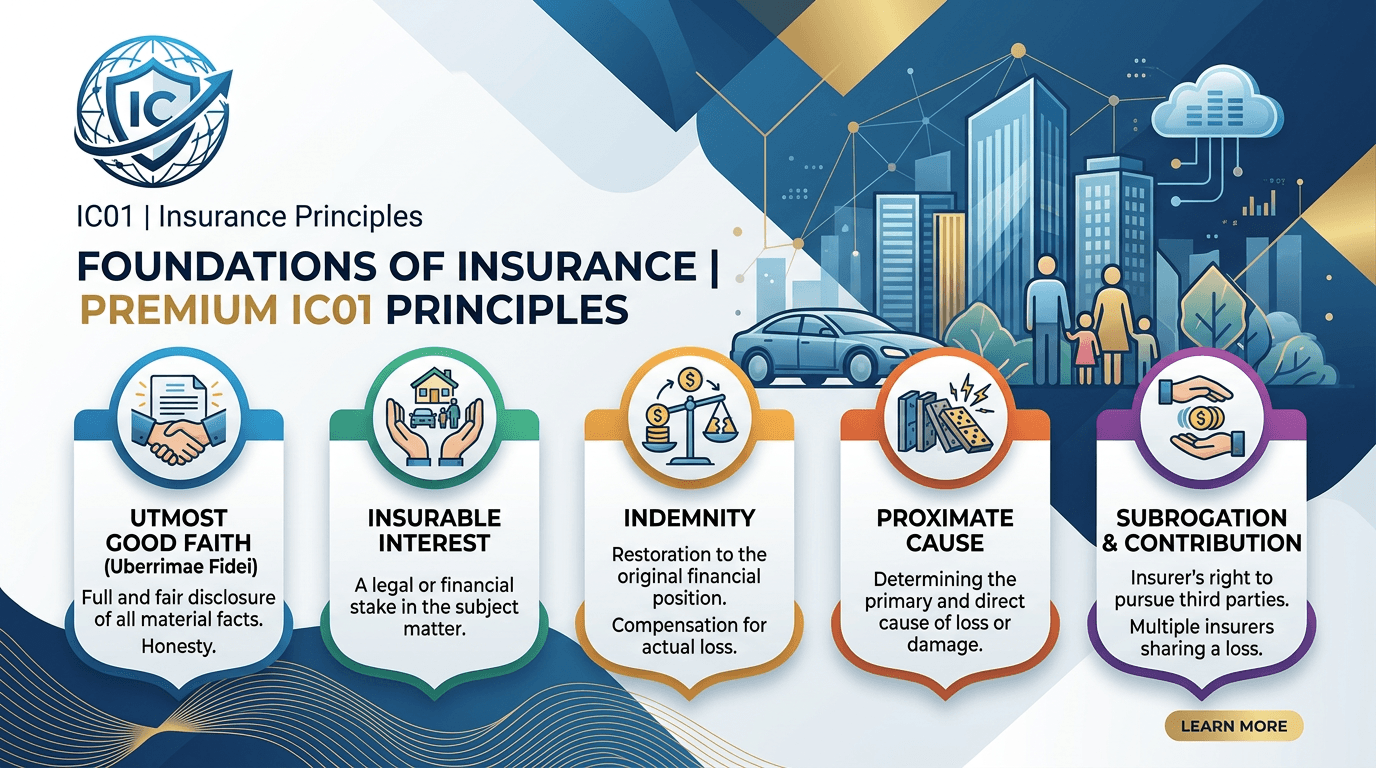
Principles of insurance infographic showing utmost good faith, insurable interest, indemnity, proximate cause, subrogation and contribution

IC 01 Principles of Insurance – Complete Guide for III Licentiate 2026

If you are preparing for the IC 01 Principles of Insurance exam, you have arrived at the right place. IC 01 is the foundation paper of the III Licentiate examination conducted by the Insurance Institute of India (III). Clearing this paper is your first step toward building a rewarding career in the insurance sector.

Thousands of insurance professionals — both freshers and working employees from PSU and private companies — appear for this exam every year. Yet many struggle because they lack the right study material, organised notes, and enough practice questions. That is exactly where Study4Insurance comes in.

In this guide, you will find everything about the IC 01 exam — the syllabus, exam pattern, key concepts, preparation strategy, common mistakes to avoid, and how Study4Insurance gives you the highest probability of clearing this exam on your very first attempt.

Start Your IC 01 Preparation Today →

Why IC 01 Principles of Insurance is Important

IC 01 is not just another exam paper. It is the gateway to your insurance career. Without clearing this paper, you cannot qualify for the III Licentiate certificate — a mandatory requirement for many insurance roles across India.

Moreover, the concepts covered in IC 01 form the backbone of all advanced insurance subjects. Whether you plan to appear for Associateship or Fellowship exams later, a strong understanding of IC 01 will make those journeys significantly easier. Therefore, investing time in IC 01 preparation is one of the smartest career decisions you can make.

  • IC 01 is compulsory for III Licentiate qualification.
  • The concepts directly apply to daily insurance work — claims, underwriting, and policy issuance.
  • A strong IC 01 foundation makes advanced papers like IC 11, IC 02, and IC 14 easier to understand.
  • It demonstrates your professional commitment and knowledge to employers.

Who Should Appear for IC 01 Principles of Insurance

The IC 01 exam is designed for a wide range of candidates. If you belong to any of the following groups, this exam is relevant for you:

  • Freshers entering the insurance industry for the first time.
  • PSU insurance employees of companies like LIC, UIIC, New India, Oriental, and National Insurance.
  • Private insurance employees who want to enhance their professional qualifications.
  • Insurance agents and intermediaries seeking formal certification.
  • Working professionals who want to formalise their insurance knowledge.
  • Candidates appearing for the III Exam 2026.

IC 01 Syllabus Overview

The IC 01 syllabus is set by the Insurance Institute of India and covers fundamental principles that govern how insurance works. Below is a structured overview of the major topic areas you need to master.

1. Nature of Insurance

This section covers the basic definition of insurance, how risk is transferred, the concept of risk pooling, and the economic and social functions of insurance. You will understand why insurance exists and how it benefits individuals and society.

2. Principles of Insurance

This is the core of IC 01. The main principles you need to study thoroughly are:

  • Utmost Good Faith (Uberrima Fides) — duty of disclosure by both parties.
  • Insurable Interest — the policyholder must have a financial stake in the subject matter.
  • Indemnity — the insured is restored to the same financial position, not profited.
  • Subrogation — the insurer steps into the shoes of the insured after paying a claim.
  • Contribution — when multiple insurers cover the same risk, they share the loss.
  • Proximate Cause — the dominant cause of loss determines claim eligibility.

3. Types and Classifications of Insurance

Life insurance, general insurance, health insurance — this section helps you distinguish between them and understand the legal framework governing each type.

4. Insurance Contract

You will learn how an insurance contract is formed, its essential elements, conditions, warranties, and exclusions. Understanding the proposal form, policy document, and premium calculation basics also fall under this topic.

5. Regulation of Insurance in India

The role of IRDAI, key provisions of the Insurance Act, and the regulatory framework for insurance companies and intermediaries are covered here. Refer to the Licentiate exam page for the official syllabus link.

6. Risk Management

Basic concepts of risk identification, assessment, control, and transfer are covered in this chapter. This section connects insurance with broader financial and business risk management.

7. Reinsurance

A brief introduction to reinsurance — why it is needed, how it works, and the types of reinsurance arrangements.

The syllabus is broad, but with the right structured approach, you can cover it efficiently. Study4Insurance has already mapped all chapters and designed chapter-wise mock tests so that you can prepare smart, not hard.

IC 01 Exam Pattern

Before you begin preparing, it is essential to understand how the exam is structured. The III Licentiate IC 01 exam follows an objective-type format, which means all questions are multiple-choice.

  • Mode: Online (Computer-Based Test)
  • Total Questions: 75
  • Duration: 90 minutes
  • Passing Marks: 50% (45 out of 75 in most cases; refer to official notification for updates)
  • Negative Marking: Yes — 25% marks deducted for each wrong answer
  • Medium: English and Hindi

Because of negative marking, accuracy matters more than speed. You must practise enough questions to develop strong conceptual clarity rather than guessing answers. This is why a robust IC 01 question bank with detailed explanations is essential.

Practice with IC 01 Mock Tests on Study4Insurance →

Key Concepts You Must Master for IC 01

Many candidates spend hours reading the textbook but still score poorly. The reason is that the IC 01 exam tests your application of concepts, not just memorisation. Here are the critical concepts where you must develop deep clarity:

Utmost Good Faith

Both the insurer and the insured must disclose all material facts honestly. A breach of this principle by the insured can lead to the policy being voided. Exam questions often present practical scenarios — you must identify whether utmost good faith has been followed or violated.

Insurable Interest

You must have a legal and financial interest in the subject matter of insurance at the time of taking the policy. For life insurance, insurable interest is required at inception. For general insurance, it is typically required at both inception and the time of loss.

Indemnity and Its Exceptions

The principle of indemnity says that insurance should put the insured back in the same financial position as before the loss — no more, no less. However, life insurance and personal accident policies are exceptions to indemnity because human life cannot be valued precisely.

Subrogation vs. Contribution

These two principles are frequently confused. Subrogation applies when the insurer pays a claim and then recovers from a third party responsible for the loss. Contribution applies when the same risk is covered by more than one insurer and they share the claim proportionately.

Proximate Cause

When a loss occurs due to a chain of events, the proximate cause is the most direct and dominant cause. The exam tests your ability to identify the proximate cause in complex scenario-based questions.

IC 01 Preparation Strategy — Prepare Smart, Not Hard

Thousands of candidates fail the IC 01 exam not because the subject is difficult but because they lack a proper strategy. Here is a proven preparation approach that Study4Insurance recommends:

Step 1: Understand the Syllabus First

Before reading any material, download and review the official syllabus from the III Exam Courses page. Know which chapters carry more weightage and plan your time accordingly.

Step 2: Study Chapter by Chapter

Do not jump between topics. Complete one chapter fully before moving to the next. Study4Insurance provides exam-oriented, chapter-wise study notes that are concise and exam-focused — eliminating the need to read bulky textbooks.

Step 3: Practise Mock Tests After Each Chapter

Reading alone is not enough. After completing each chapter, take the chapter-wise mock test on Study4Insurance. This reinforces your understanding and highlights weak areas immediately.

Step 4: Solve Memory-Based Previous Year Questions

IC 01 previous year questions and memory-based questions give you a real picture of the exam pattern. Study4Insurance has compiled thousands of such questions with detailed explanations to help you prepare with confidence.

Step 5: Revise Regularly

Set aside revision time every week. With Study4Insurance’s quick revision notes, you can cover an entire chapter in 15–20 minutes. Regular revision ensures that concepts stay fresh in your memory until exam day.

Step 6: Take Full-Length Mock Tests

In the final two weeks before the exam, take at least 5–7 full-length mock tests. This builds your time management skills and exam temperament. Analyse your performance after each test using the performance tracking feature on Study4Insurance.

Common Mistakes Candidates Make in IC 01 Preparation

Understanding what not to do is as important as knowing what to do. Here are the most common mistakes that IC 01 aspirants make:

  • Skipping chapters assuming they are less important — every chapter contributes to the final score.
  • Not practising mock tests — reading without testing creates a false sense of preparedness.
  • Ignoring negative marking — guessing answers without knowledge leads to score deductions.
  • Studying from outdated material — the syllabus and exam pattern get updated; always use current study material.
  • Studying too late — last-minute preparation rarely works for insurance exams. Start at least 4–6 weeks before the exam.
  • Not revising — candidates often read once and never revise, leading to poor retention.

Study4Insurance is built to solve every one of these problems — with updated content, chapter-wise tests, performance analytics, and expert support through Telegram.

How to Pass IC 01 Principles of Insurance in Your First Attempt

Clearing IC 01 in the first attempt is absolutely achievable with the right preparation. Here is what successful candidates have in common:

  • They start at least 4–6 weeks early.
  • They use structured, exam-oriented material — not just the raw textbook.
  • They practise a minimum of 500–800 questions before the exam.
  • They take full mock tests under timed conditions.
  • They join a community where they can clear doubts and stay motivated.
  • They revise key concepts at least twice before the exam.

Study4Insurance is designed to help candidates clear the IC 01 exam aimed at maximising first-attempt success. Everything you need — material, mock tests, questions, notes, and support — is available in one place.

Join Thousands of Successful Aspirants — Enrol Now →

Why Choose Study4Insurance for IC 01 Preparation
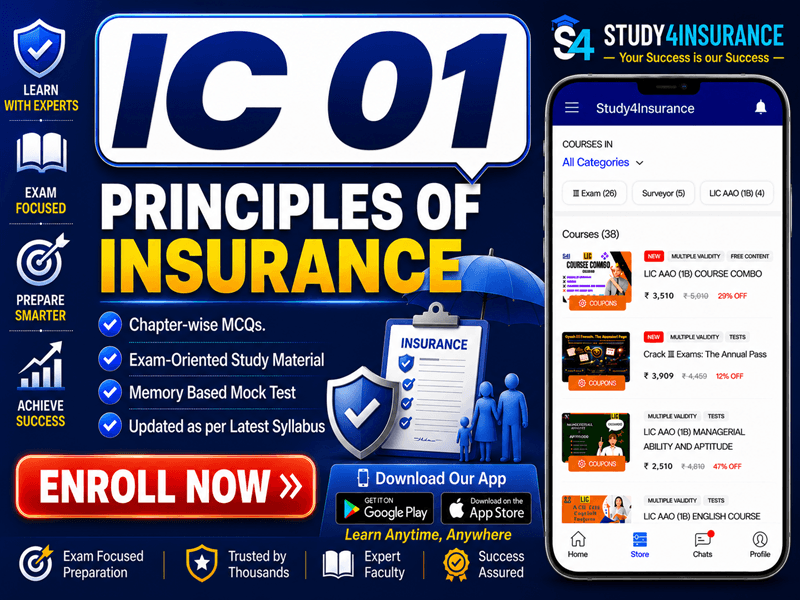
Study4Insurance IC 01 Principles of Insurance course features

Study4Insurance is India’s dedicated insurance exam preparation platform — built specifically for III Licentiate, Associateship, Fellowship, GIPSA, LIC AAO, Para 13.2, and Surveyor exam aspirants. We are not a generic coaching app. We understand insurance exams deeply because our faculty and content team are insurance professionals themselves.

Trusted by thousands of insurance professionals across India, Study4Insurance has helped candidates from LIC, New India, UIIC, Oriental, National, and leading private insurers clear their exams confidently.

What Makes Study4Insurance Different

  • 100% exam-focused content — every word in our notes is written keeping the exam in mind.
  • Memory-based questions — thousands of questions sourced from actual exam experiences of past candidates.
  • Chapter-wise mock tests — test your understanding after every chapter, not just at the end.
  • Detailed explanations — every question comes with a clear explanation so you learn from every attempt.
  • Latest syllabus coverage — content is updated regularly to reflect any changes in the exam pattern.
  • Mobile + Web access — study on your smartphone, tablet, or laptop, anywhere and anytime.
  • Unlimited attempts during validity — practise as many times as you need without worrying about limits.
  • Performance analysis — track your chapter-wise and topic-wise scores to focus on weak areas.
  • Quick revision notes — compact, high-impact notes designed for last-week revision.
  • Expert faculty support — get your doubts resolved by experienced insurance professionals.
  • Private Telegram support group — stay connected, get updates, and stay motivated with a community of fellow aspirants.
  • Regular content updates — we continuously add new questions and refresh content based on the latest exam trends.

IC 01 Course Features at a Glance

  • ✔ Chapter-wise Mock Tests
  • ✔ Memory-Based Questions from Previous Exams
  • ✔ Latest Exam Pattern Coverage
  • ✔ Updated IC 01 Syllabus
  • ✔ Detailed Solutions and Explanations
  • ✔ Quick Revision Notes
  • ✔ Unlimited Attempts During Validity
  • ✔ Mobile Learning via App
  • ✔ Performance Tracking and Analysis
  • ✔ Telegram Doubt-Clearing Support
  • ✔ Continuous Content Updates

Practice Smarter with Study4Insurance — Enrol Today →

Addressing Your Concerns — We Have the Answers

“I don’t have enough time to prepare.”

We understand that most candidates are working professionals. Study4Insurance is designed for mobile-first, bite-sized learning. You can study during your commute, lunch break, or even 30 minutes before bed. Even 1 hour a day for 4–6 weeks is sufficient if you follow our structured plan.

“The IC 01 syllabus seems huge.”

Yes, the syllabus looks extensive at first. But with our chapter-wise breakdown and exam-focused notes, you will realise that the actual exam-testable content is much more manageable. We eliminate all the unnecessary text and give you exactly what you need.

“I failed IC 01 before and I’m not confident.”

A previous failure simply means you needed a better strategy. Many of our successful students failed once or twice before joining Study4Insurance. With our mock tests, detailed explanations, and performance analytics, you will identify exactly why you failed and fix those gaps systematically.

“I don’t know where to start.”

Start with our IC 01 course. The content is arranged chapter by chapter in the correct sequence. You simply log in and follow the plan. No confusion, no guesswork.

“I don’t have proper notes.”

Our exam-oriented study notes are concise, well-structured, and written by insurance professionals. You do not need any other book or resource.

“I need more mock tests and previous year questions.”

Study4Insurance gives you access to thousands of memory-based practice questions and multiple full-length mock tests — all with detailed solutions. Unlimited attempts mean you can practise until you are fully confident.

Free Resources for IC 01 Preparation

We believe that every insurance aspirant deserves access to quality resources. That is why Study4Insurance also provides free resources to help you get started:

Join our Telegram channel for free daily practice: Study4Insurance Telegram Channel

Download the Study4Insurance App

Study anywhere, anytime with the Study4Insurance mobile app. The app gives you full access to all IC 01 mock tests, notes, and practice questions on your smartphone.

ORG Code for App Login: KHABHQ

Use ORG Code: KHABHQ when logging in through the iPhone app or the web portal.

Explore Other III Exam Courses

Planning to clear multiple III papers? Study4Insurance covers all major Licentiate, Associateship, and Fellowship subjects. Here are some popular courses to explore after IC 01:

You can also browse the full list of available courses at Study4Insurance Course Library.

Enrol in IC 01 Now — Start Preparing Today →

Frequently Asked Questions — IC 01 Principles of Insurance

1. What is IC 01 Principles of Insurance?

IC 01 Principles of Insurance is a compulsory paper in the III Licentiate examination conducted by the Insurance Institute of India. It covers the foundational principles of insurance, including utmost good faith, insurable interest, indemnity, subrogation, contribution, and proximate cause, along with the regulatory framework and types of insurance in India.

2. Is IC 01 difficult to pass?

IC 01 is not exceptionally difficult, but it requires a structured preparation approach. The exam tests your conceptual understanding and application of principles. With proper study material, regular mock test practice, and consistent revision, most candidates can clear it in their first attempt.

3. What is the passing marks for IC 01?

The passing threshold for IC 01 is generally 60% of the total marks. Candidates are advised to confirm the latest passing criteria from the official Insurance Institute of India notification before their exam.

4. Does IC 01 have negative marking?

No, IC 01 has no negative marking. However, it is important to attempt only questions you are reasonably confident about and avoid blind guessing.

5. Where can I find IC 01 study material and notes?

Study4Insurance provides comprehensive IC 01 study material including exam-oriented notes, chapter-wise mock tests, memory-based questions, and quick revision notes. You can access all of this through the IC 01 course on Study4Insurance.

6. Are there IC 01 previous year questions available?

Yes. Study4Insurance has compiled memory-based questions sourced from previous IC 01 exam experiences of candidates. These questions are available with detailed solutions to help you understand the correct approach for each concept.

7. Is there a free IC 01 mock test available?

Study4Insurance offers a free Telegram community where daily practice questions and exam tips are shared. Join the III Exam Telegram Group to access free resources. For comprehensive mock tests with full solutions, the IC 01 course provides unlimited practice.

8. How many months do I need to prepare for IC 01?

Most candidates clear IC 01 with 4–6 weeks of dedicated preparation, spending 1–2 hours daily. Working professionals who can manage consistent daily study generally find this timeline comfortable. Candidates appearing for the first time are advised to start preparation at least 6 weeks before the exam date.

9. Can I prepare for IC 01 on my mobile phone?

Absolutely. The Study4Insurance app is available on both Android (Google Play) and iPhone (App Store). Use ORG Code KHABHQ to log in. All course content, mock tests, and notes are fully accessible on mobile.

10. What is the syllabus for IC 01 Principles of Insurance?

The IC 01 syllabus covers the nature of insurance, all fundamental insurance principles, types and classifications of insurance, insurance contracts, IRDAI regulations, risk management basics, and reinsurance fundamentals. Refer to the official III Licentiate page for the detailed chapter-wise syllabus breakdown.

Conclusion — Your IC 01 Success Starts Here

Clearing IC 01 Principles of Insurance is your first milestone on the path to professional excellence in the insurance industry. The exam is absolutely manageable — provided you prepare with the right resources and follow a structured strategy.

Study4Insurance has been purpose-built to give every insurance aspirant the tools they need to succeed. From exam-oriented notes and chapter-wise mock tests to thousands of memory-based questions and expert Telegram support, everything is in one place and accessible on your mobile or desktop.

Do not wait until the last minute. The candidates who enrol early, practise consistently, and revise regularly are the ones who clear IC 01 on their very first attempt. Start today and maximise your chances of success.

Trusted by thousands of insurance professionals. Designed specifically for III Licentiate aspirants. Built to help you clear the exam in your very first attempt.

Enrol in IC 01 Now — Start Your Preparation Today →

Already preparing for other exams? Explore our full range of courses:

Join our free Telegram communities: III Exam Group | Main Channel | GIPSA Group | LIC AAO Group | Para 13.2 Group
IC 02 PRACTICE OF LIFE INSURANCE

IC 02 Practice of Life Insurance Mock Test for III Licentiate Exam - Study4Insurance

IC 02 Practice of Life Insurance – Complete Guide for III Licentiate 2026

Are you preparing for the IC 02 Practice of Life Insurance exam? Whether you are a fresher entering the insurance industry or a working professional at LIC, UIIC, or any private insurer, clearing IC 02 is a significant milestone in your career. This paper is one of the core subjects in the III Licentiate examination conducted by the Insurance Institute of India (III), and it tests your practical knowledge of how life insurance actually works.

Many candidates find IC 02 challenging because it goes beyond theory. It demands that you understand life insurance operations, products, underwriting, claims, and customer service from a practical perspective. The good news is that with the right preparation strategy, clearing IC 02 in your first attempt is entirely achievable.

This guide covers everything you need — the syllabus, exam pattern, key concepts, preparation strategy, common mistakes, and how Study4Insurance gives you the best possible chance of success. If you have already cleared IC 01 Principles of Insurance, IC 02 is your natural next step.

Start Your IC 02 Preparation Today →

Why IC 02 Practice of Life Insurance is Important

IC 02 is not simply an exam you clear and forget. The knowledge it builds directly applies to your daily work in the insurance industry. Life insurance professionals — whether in sales, underwriting, claims, or operations — deal with the concepts covered in this paper every single day.

Moreover, IC 02 is a compulsory paper for the III Licentiate qualification. Without clearing it, your Licentiate certification remains incomplete. Therefore, investing properly in IC 02 preparation is both a professional and career necessity.

  • IC 02 is mandatory for III Licentiate qualification alongside IC 01 and other papers.
  • The practical knowledge directly applies to LIC and private life insurance operations.
  • A strong IC 02 foundation makes advanced Associateship papers like IC 22 Life Insurance Underwriting and IC 26 Life Insurance Finance significantly easier.
  • It enhances your credibility and professional standing within your organisation.
  • Licentiate qualification is often a prerequisite for promotion in PSU insurance companies.

Who Should Appear for IC 02 Practice of Life Insurance

IC 02 is relevant for a broad range of insurance professionals and aspirants. If you fall into any of these categories, this exam directly benefits your career:

  • LIC employees required to qualify for the Licentiate certificate.
  • Private life insurance employees seeking professional certification.
  • Freshers who have joined the insurance sector and need to clear their Licentiate exams.
  • PSU general insurance employees who handle life insurance-related products or are cross-qualifying.
  • Insurance agents and advisors who want to deepen their product knowledge.
  • Candidates appearing for the III Exam 2026 seeking to complete their Licentiate papers.

IC 02 Syllabus Overview

The IC 02 syllabus is set by the Insurance Institute of India and covers the practical aspects of life insurance operations in India. Unlike IC 01, which focuses on principles, IC 02 goes into the actual workings of life insurance — products, underwriting, policy servicing, claims, and more.

1. Life Insurance Products

This section covers the different types of life insurance plans available in India — term insurance, endowment plans, whole life policies, money-back plans, ULIPs, annuities, and pension products. You need to understand the features, benefits, and suitability of each product type.

2. Proposal and Underwriting

How does a life insurance company decide whether to accept a risk? This chapter explains the proposal process, the role of the agent, medical underwriting, financial underwriting, and the factors that influence risk assessment. Understanding why certain applications are declined or loaded is essential for this topic.

3. Premium Calculation and Modes

This section deals with how life insurance premiums are calculated, the factors that affect premium rates, and the different modes of premium payment — yearly, half-yearly, quarterly, and monthly. Concepts like premium loading, rebates, and grace periods are covered here.

4. Policy Document and Conditions

You will study the structure of a life insurance policy document — what it contains, key conditions and warranties, the free-look period, policy revival procedures, assignment, nomination, and lapsation rules.

5. Policy Servicing

This chapter covers all post-issuance services — loans against policies, surrender values, paid-up values, revival of lapsed policies, change of nomination, and duplicate policy issuance. These are highly practical topics directly relevant to insurance operations roles.

6. Claims Settlement

One of the most important sections of IC 02. It covers the life insurance claims process — maturity claims, death claims, early claims, investigation procedures, documents required, and the role of the claims department. Exam questions here are frequently scenario-based.

7. Reinsurance in Life Insurance

A brief overview of why life insurers use reinsurance, types of reinsurance arrangements used in life insurance, and how reinsurance protects the insurer against large claims.

8. Regulatory Framework

The role of IRDAI in regulating life insurance companies, consumer protection guidelines, grievance redressal mechanisms, and key provisions of the Insurance Act relevant to life insurance practice.

The syllabus is comprehensive, but Study4Insurance breaks it down chapter by chapter with focused, exam-oriented notes that eliminate everything irrelevant. Prepare smart, not hard.

IC 02 Exam Pattern

Before you begin your preparation, it is important to understand the structure of the IC 02 exam. Like all III Licentiate papers, IC 02 follows an objective multiple-choice format.

  • Mode: Online (Computer-Based Test)
  • Total Questions: 75
  • Duration: 90 minutes
  • Passing Marks: 50% (refer to the official III notification for the latest cut-off)
  • Negative Marking: Yes — 25% marks deducted for each wrong answer
  • Medium: English and Hindi

The presence of negative marking makes IC 02 a test of both knowledge and judgment. Guessing answers without conceptual understanding is dangerous. This is why practising a large volume of questions with detailed explanations is essential — so you can answer confidently rather than guess blindly.

Practice IC 02 Mock Tests on Study4Insurance →

Key Concepts You Must Master for IC 02

IC 02 is practical in nature, and the exam reflects this. Many questions present real-world scenarios where you must apply your knowledge. Here are the most critical concepts to master:

Types of Life Insurance Plans

You must clearly understand the differences between term, endowment, whole life, money-back, ULIP, and annuity products. Exam questions often test whether you can identify the right product for a given customer scenario or compare two plan types based on their features.

Underwriting Decisions

Understanding how insurers assess life insurance risk is crucial. You need to know the factors that lead to standard acceptance, substandard loading, postponement, or outright decline of a proposal. Medical history, occupation, lifestyle, and financial background all play a role.

Premium Concepts — Loading, Rebates, and Grace Period

Be clear about what modal loading means and how it affects premiums across different payment frequencies. Understand rebates available on high sum assured amounts and the implications of the grace period for premium payment.

Surrender Value vs. Paid-Up Value

These two concepts are frequently confused. Surrender value is the amount payable when a policyholder terminates the policy before maturity. Paid-up value is the reduced sum assured when a policyholder stops paying premiums but keeps the policy in force. Exam questions often test the distinction between these.

Death Claim Procedures

The death claims process — documents required, early claim investigation, role of the nominee, timelines, and the difference between maturity and death claim settlement — is a heavily tested area in IC 02. Pay particular attention to early claims and the circumstances under which investigation is triggered.

Nomination and Assignment

Understand the legal implications of nomination versus assignment. Who gets the claim proceeds, under what conditions, and what happens when there is a conflict between a nominee and a legal heir — these are common exam scenarios.

IC 02 Preparation Strategy — Prepare Smart, Not Hard

Most candidates who fail IC 02 do so not because the subject is beyond them, but because they lack a structured preparation plan. Here is a proven six-step strategy that Study4Insurance recommends:

Step 1: Map the Syllabus Before You Begin

Start by reviewing the complete IC 02 syllabus from the III Exam Courses page. Identify which chapters carry higher weightage and allocate your study time accordingly.

Step 2: Study One Chapter Completely Before Moving On

Avoid the temptation to skim multiple chapters. Complete one chapter thoroughly — read the notes, understand the concepts, and take the chapter-wise mock test before proceeding. Study4Insurance’s notes are written in simple, exam-focused language that makes each chapter manageable.

Step 3: Take Chapter-Wise Mock Tests Immediately

After every chapter, attempt the corresponding mock test on Study4Insurance. This approach immediately tests your retention and highlights the gaps you need to address before they accumulate.

Step 4: Practise Memory-Based Previous Year Questions

IC 02 previous year questions and memory-based questions give you direct insight into the type of scenarios the exam presents. Study4Insurance has compiled thousands of such questions with detailed solutions to sharpen your exam readiness.

Step 5: Revise Weekly with Quick Notes

Do not wait until the last week to revise. Set aside one session every week to revisit completed chapters using Study4Insurance’s quick revision notes. This keeps concepts fresh and builds long-term retention.

Step 6: Simulate Full Exam Conditions

In the 10–14 days before your exam, take at least 5 full-length mock tests under timed conditions. Use the performance analytics on Study4Insurance to identify your weakest chapters and focus your final revision there.

Common Mistakes to Avoid in IC 02 Preparation

Learning from others’ mistakes can save you significant time and effort. Here are the most common errors IC 02 candidates make:

  • Treating IC 02 like IC 01 — IC 02 is more practical. Conceptual memory alone is not enough; you need to apply knowledge to scenarios.
  • Skipping the claims chapter — claims is one of the most heavily tested areas. Never skip it.
  • Not practising enough questions — reading notes is necessary but not sufficient. Mock tests and question banks are equally important.
  • Using outdated study material — the exam pattern and regulatory guidelines evolve. Always use current, updated content.
  • Starting too late — candidates who begin preparation less than 3 weeks before the exam rarely perform well. Start at least 4–6 weeks early.
  • Ignoring negative marking — attempting uncertain answers reduces your final score. Build the accuracy discipline through regular practice.

How to Pass IC 02 Practice of Life Insurance in Your First Attempt

First-attempt success in IC 02 is within reach for any candidate who prepares with the right approach. Here is what consistently successful candidates do differently:

  • They start preparation at least 5–6 weeks before the exam.
  • They use structured, exam-oriented notes rather than reading the entire textbook cover to cover.
  • They practise a minimum of 600–900 questions before sitting for the exam.
  • They take full-length timed mock tests to build exam temperament and time management skills.
  • They stay connected to a community for doubt resolution, motivation, and last-minute tips.
  • They complete at least two full rounds of revision before the exam.

Study4Insurance is built to support every one of these habits. It is aimed at maximising first-attempt success for III Licentiate aspirants — giving you everything you need in one organised, mobile-friendly platform.

Join Thousands of Successful Aspirants — Enrol Now →

Why Choose Study4Insurance for IC 02 Preparation

IC 02 Practice of Life Insurance complete guide for III Licentiate exam 2026

Study4Insurance is India’s dedicated insurance exam preparation platform, built exclusively for insurance professionals. Unlike generic competitive exam platforms, Study4Insurance understands the III exam ecosystem deeply — because our faculty and content team are insurance professionals themselves.

Trusted by thousands of insurance professionals across India — from LIC, New India, UIIC, Oriental, National, and leading private insurers — Study4Insurance has consistently helped candidates clear their Licentiate, Associateship, and Fellowship papers with confidence.

What Makes Study4Insurance the Right Choice for IC 02

  • Exam-focused study material — every note is written specifically for the IC 02 exam, not adapted from a generic insurance textbook.
  • Thousands of memory-based practice questions — sourced from real exam experiences of past candidates, giving you the closest possible simulation of the actual exam.
  • Chapter-wise mock tests — test your understanding chapter by chapter so that weaknesses are caught and corrected early.
  • Detailed solutions and explanations — every question comes with a thorough explanation so that each attempt builds your understanding, not just your score.
  • Latest syllabus and pattern coverage — content is reviewed and updated regularly to reflect the latest III exam guidelines.
  • Mobile App and Web access — study on your smartphone, tablet, or laptop. Available on Android and iPhone.
  • Unlimited attempts during validity — practise as many times as you need without any additional charge.
  • Performance tracking and analytics — identify your strongest and weakest chapters with detailed score breakdowns after every test.
  • Quick revision notes — compact, high-impact revision summaries designed for the final week before the exam.
  • Expert faculty support — get your doubts answered by experienced insurance professionals who understand both the subject and the exam.
  • Private Telegram support group — stay connected, get exam alerts, and solve doubts in a community of fellow IC 02 aspirants.
  • Continuous content updates — new questions and updated notes are added regularly based on the latest exam trends.

IC 02 Course Features at a Glance

  • ✔ Chapter-wise Mock Tests
  • ✔ Memory-Based Questions from Previous Exams
  • ✔ Latest Exam Pattern Coverage
  • ✔ Updated IC 02 Syllabus
  • ✔ Detailed Solutions and Explanations
  • ✔ Quick Revision Notes
  • ✔ Unlimited Attempts During Validity
  • ✔ Mobile Learning via App
  • ✔ Performance Tracking and Analysis
  • ✔ Telegram Doubt-Clearing Support
  • ✔ Continuous Content Updates

Practice Smarter with Study4Insurance — Enrol in IC 02 Today →

We Understand Your Concerns — Here is How We Solve Them

“I don’t have enough time to study for IC 02.”

Most IC 02 candidates are working professionals with demanding schedules. Study4Insurance is designed for exactly this situation. With mobile-first, bite-sized content, you can study during your commute, lunch break, or in the evening. Even 45–60 minutes of focused daily study for 5–6 weeks is enough to cover the entire syllabus and practise sufficient questions.

“The IC 02 syllabus looks very large.”

The syllabus does appear extensive at first glance. However, Study4Insurance breaks it down into focused, chapter-wise modules. Each chapter is covered through concise notes and targeted mock tests — so you always know exactly what you need to study and what you can safely skip.

“I failed IC 02 before and I’m not sure if I can clear it.”

A previous failure is not a reflection of your ability — it means you needed a better strategy and better resources. Many of our most successful students failed once or twice before joining Study4Insurance. With our performance analytics, you can pinpoint exactly which chapters or concept types caused your previous failure and address them systematically.

“I don’t know where to start with IC 02.”

Simply log in to Study4Insurance, open the IC 02 course, and begin with Chapter 1. The content is arranged in the correct sequence, chapter by chapter. There is no confusion about what to study first or how to organise your preparation.

“I don’t have proper IC 02 notes.”

Study4Insurance provides exam-oriented, professionally written notes for every IC 02 chapter. These notes are concise, clear, and written with one purpose — helping you answer exam questions correctly. You do not need any additional book or resource.

“I need more IC 02 mock tests and previous year questions.”

Study4Insurance gives you access to thousands of memory-based practice questions, chapter-wise tests, and full-length mock exams — all with detailed explanations. With unlimited attempts during your validity period, you can practise until you are genuinely confident.

Free Resources for IC 02 Preparation

Study4Insurance believes every insurance aspirant deserves a strong start. That is why we offer free resources alongside our premium course:

Join the free Telegram channel for daily IC 02 practice questions: Study4Insurance Telegram Channel

Download the Study4Insurance App

Take your IC 02 preparation anywhere with the Study4Insurance mobile app. All course content, mock tests, notes, and performance reports are fully accessible on your smartphone.

ORG Code for App and Web Login: KHABHQ

Use ORG Code: KHABHQ when logging in through the iPhone app or the web portal to access your course.

Explore Other III Exam Courses on Study4Insurance

Preparing for multiple Licentiate or Associateship papers? Study4Insurance covers the full range of III exam subjects. Here are popular courses to explore alongside IC 02:

Browse the complete course library at Study4Insurance Course Library.

Enrol in IC 02 Now — Start Preparing Today →

Frequently Asked Questions — IC 02 Practice of Life Insurance

1. What is IC 02 Practice of Life Insurance?

IC 02 Practice of Life Insurance is a compulsory paper in the III Licentiate examination conducted by the Insurance Institute of India. It covers the practical aspects of life insurance in India — including products, underwriting, premium calculation, policy servicing, claims settlement, nomination, assignment, and regulatory compliance under IRDAI guidelines.

2. Is IC 02 harder than IC 01?

IC 02 is different from IC 01, not necessarily harder. While IC 01 focuses on fundamental insurance principles, IC 02 tests your practical understanding of life insurance operations. Candidates who work in life insurance often find IC 02 more relatable. However, those from a general insurance background may need more focused preparation on life-specific products and procedures.

3. What is the passing marks for IC 02?

The passing threshold for IC 02 is generally 60% of the total marks. Candidates should confirm the latest passing criteria from the official Insurance Institute of India notification before their exam, as this may be subject to revision.

4. Does IC 02 have negative marking?

No. However, Regular mock test practice builds the discipline needed to avoid guessing.

5. Where can I find IC 02 study material and notes PDF?

Study4Insurance provides comprehensive IC 02 study material, including exam-oriented chapter notes, chapter-wise mock tests, memory-based questions, and quick revision summaries. Access all of this through the IC 02 course on Study4Insurance.

6. Are IC 02 previous year questions available on Study4Insurance?

Yes. Study4Insurance has compiled thousands of memory-based questions drawn from the actual exam experiences of past IC 02 candidates. These questions are available with detailed explanations to help you understand exactly how the exam tests each concept.

7. Is there a free IC 02 mock test available?

Study4Insurance provides daily practice questions and exam tips through the free III Exam Telegram Group. For comprehensive mock tests with full solutions and performance analysis, the IC 02 course offers unlimited practice within the validity period.

8. How many weeks does IC 02 preparation take?

Most candidates clear IC 02 with 4–6 weeks of structured preparation, dedicating 1–2 hours daily. Working professionals who study consistently find this timeline very manageable. Starting at least 5–6 weeks before the exam date is strongly recommended.

9. Can I study IC 02 on my mobile phone?

Yes. The Study4Insurance app is available on both Android (Google Play) and iPhone (App Store). Use ORG Code: KHABHQ to log in. All notes, mock tests, and performance reports are fully mobile-accessible.

10. What is the difference between IC 01 and IC 02?

IC 01 Principles of Insurance covers the foundational principles that govern all insurance — such as utmost good faith, indemnity, insurable interest, and subrogation. IC 02 Practice of Life Insurance, on the other hand, focuses specifically on how life insurance is practised in India — covering products, underwriting, policy servicing, and claims. Both are compulsory for the III Licentiate qualification.

Conclusion — Your IC 02 Success Journey Starts Here

IC 02 Practice of Life Insurance is a paper that directly connects to your work as an insurance professional. The concepts you master here will serve you every day — in customer conversations, policy servicing, underwriting decisions, and claims processing.

Clearing IC 02 in your first attempt is completely achievable. All you need is the right study material, a consistent daily practice routine, and a platform that genuinely supports your preparation journey. Study4Insurance provides all of this — with chapter-wise mock tests, thousands of memory-based questions, expert notes, performance tracking, and a live Telegram community to keep you on track.

Thousands of insurance professionals across India have already trusted Study4Insurance to prepare for their III exams. Join them today and give yourself the best possible chance of clearing IC 02 Practice of Life Insurance in your very first attempt.

Designed specifically for III Licentiate aspirants. Trusted by thousands of insurance professionals. Built to maximise your chances of first-attempt success.

Enrol in IC 02 Now — Start Your Preparation Today →

Preparing for other exams as well? Explore these resources:

Join our free Telegram communities: III Exam Group | Main Channel | GIPSA Group | LIC AAO Group | Para 13.2 Group | Surveyor Exam Group

IC 57 Fire Insurance Notes: Chapter-wise

If you are preparing for the IC 57 – Fire and Consequential Loss Insurance paper of the Insurance Institute of India, having clear, chapter‑wise IC 57 Fire and Consequential Loss Insurance Notes makes all the difference. Most candidates struggle because the book is dense, technical, and usually available as one long PDF, which is hard to revise quickly. In particular, mastering IC 57 Fire Insurance concepts is vital for exam success.

On this page, you will find a structured, chapter‑wise hub for IC 57 Fire and Consequential Loss Insurance Notes.

1. What is IC 57 – Fire and Consequential Loss Insurance?

IC 57 is an Associateship-level paper of the Insurance Institute of India focused on Fire and Consequential Loss Insurance. It covers material damage policies, fire hazards and prevention, tariffs, underwriting, claims handling, and loss of profits due to business interruption. Therefore, it is important to understand all aspects related to Fire Insurance, especially those outlined in the IC 57 syllabus.

The subject is critical for general insurance officers, surveyors, underwriters, and anyone dealing with property and fire insurance portfolios in India. Having IC 57 Fire and Consequential Loss Insurance Notes is essential for success.

2. IC 57 Syllabus and Chapter-wise Structure

As per standard references and III-aligned study material, the IC 57 syllabus is usually divided into the following chapters:

  • Chapter 1: Basic Principles and the Fire Policy
  • Chapter 2: Add-On Covers and Special Policies
  • Chapter 3: Fire Hazards and Fire Prevention
  • Chapter 4: Erstwhile Fire Tariff – Rules and Rating
  • Chapter 5: Documents
  • Chapter 6: Underwriting
  • Chapter 7: Claims – Legal Aspects
  • Chapter 8: Claims – Procedural Aspects
  • Chapter 9: Consequential Loss Insurance – I
  • Chapter 10: Consequential Loss Insurance – II
  • Chapter 11: Specialised Policies and Overseas Practice

On this page, we will gradually add separate chapter-wise links so that you can open each chapter on a clean, dedicated page for reading and revision. Today, we are starting with Chapter 1. Moreover, these IC 57 Fire and Consequential Loss Insurance Notes will help streamline your revision process. For those who want to focus on IC 57 Fire Insurance, these resources will be immensely helpful.

3. How to Use These IC 57 Notes

To get maximum value from this chapter-wise IC 57 resource:

  • Start with Chapter 1 and read it completely at least once. As you go, pay special attention to the IC 57 Fire Insurance portions for best results.
  • While revising, use the chapter-wise link to jump directly to the topics you are weak in (for example, Indemnity or Proximate Cause).
  • Combine these notes with III’s official book and a few mock tests so that concepts and questions are covered together.
IC-57 Fire Insurance – Complete Notes | Study4Insurance

🔥 IC-57 Complete Study Notes

Click any chapter below to open full notes — diagrams, formulas, exam tips & memory tricks included

📖 11 Chapters 🧠 Memory Tricks 📝 Exam Points 📐 Flowcharts 🔢 All Formulas 🗂️ Revised Edition 2025
Chapter 1

Basic Principles & The Fire Policy

6 Principles12 Perils 13 Exclusions15 Conditions BSUS/BLUS
📖 Read Chapter →
Chapter 2

Add-On Covers & Special Policies

15 Add-OnsRIV Clause Declaration PolicyFloater Policy
📖 Read Chapter →
Chapter 3

Fire Hazards & Fire Prevention

Originating HazardsFire Load Fire ResistanceFire Triangle
📖 Read Chapter →
Chapter 4

Erstwhile Tariff – Rules & Rating

Short Period RatesRating Sections DiscountsPer Se Rating
📖 Read Chapter →
Chapter 5

Documents

Proposal FormRisk Inspection Cover NoteEndorsements
📖 Read Chapter →
Chapter 6

Underwriting

PML / EMLReinsurance Quota ShareCRESTA
📖 Read Chapter →
Chapter 7

Claims – Legal Aspects

Proximate CauseWarranties Ex-GratiaIndemnity
📖 Read Chapter →
Chapter 8

Claims – Procedural Aspects

72 Hours RuleSurvey Report Time LimitsLoss Assessment
📖 Read Chapter →
Chapter 9

Consequential Loss – I

Gross ProfitTurnover Basis Indemnity PeriodClaim Formula
📖 Read Chapter →
Chapter 10

Consequential Loss – II

Wages InsuranceOutput Basis Difference BasisLay-Off
📖 Read Chapter →
Chapter 11

Specialised Policies & Overseas

Petrochemical TariffIAR Policy UK PracticeUS Practice
📖 Read Chapter →
⚡ Quick Exam Numbers – IC-57
📅 Key Dates
Insurance Act: 1938 | Indian Contract Act: 1872
Fire tariff withdrawn: Jan 2007
Petrochem Tariff: 1976 | IAR: 1 Jul 1997
BSUS/BLUS: 2021 | CRESTA: 1977
📊 Key %s
Deductible: 5% (min ₹10,000)
Architect fees (policy): 3% | Add-on: 7.5%
Debris removal: 1% | Add-on: 10%
Declaration refund max: 50%
CL basis rate: 1.25× fire rate
⏱️ Time Limits
Written claim: 15 days
Surveyor appointed: 72 hours
Surveyor report: 30 days (max 6 months)
Settlement offer: 30 days of report
Payment after acceptance: 7 days
Chapter 1

Basic Principles & The Fire Policy

📜 6 Principles🔥 12 Perils ⚠️ 13 Exclusions📋 15 Conditions🏛️ BSUS/BLUS

1. Definition of Fire Insurance

Legal Definition – Section 2, Insurance Act 1938 Business of effecting contracts of insurance against loss by or incidental to fire or other occurrence customarily included among fire insurance risks.
  • Policy is usually for 1 year (residential houses can exceed 1 year)
  • Insurer liable only to extent of actual loss — no loss = no liability even if fire occurred
  • Subject matter: any moveable or immovable property with pecuniary (financial) value
⭐ EXAM POINTPerils classified as: (i) Social – riot, strike; (ii) Natural – storm, flood; (iii) Miscellaneous – aircraft, impact

2. Five Essential Elements of a Valid Contract

5 Elements of a Valid Fire Insurance Contract
Offer & Acceptance
Consideration (Premium)
Agreement
Legal Competence
Legality

3. Six Basic Principles of Insurance

🤝 1. Utmost Good Faith
  • Disclose ALL material facts
  • Duty continues throughout policy (Condition 3)
  • Breach → contract void/voidable
⚖️ 2. Indemnity
  • Same financial position as before loss
  • No profit allowed
  • Subject to sum insured
💡 3. Insurable Interest
  • Must exist at inception, during, AND at loss
  • Legal right + pecuniary relationship
  • Property sold → policy does NOT auto-transfer
🔗 4. Proximate Cause
  • “Immediate and not the remote cause”
  • Latin: causa proxima non remota spectatur
🔄 5. Contribution
  • Multiple policies on same property
  • Each insurer pays rateable proportion
  • Corollary of Indemnity
↔️ 6. Subrogation
  • Insured’s rights against 3rd party → transferred to insurer
  • After insurer pays claim
  • Corollary of Indemnity
⭐ MOST ASKED MCQContribution & Subrogation are BOTH corollaries of Principle of INDEMNITY

4. Bases of Sum Insured

PropertyBasis
Buildings, Plant, Machinery, FixturesMarket Value OR Reinstatement Value
Other contents, HouseholdMarket Value only
Art, manuscripts, obsolete machinery, heritage buildingsAgreed Value
Raw MaterialsMarket Value (purchase cost)
Semi-finished goodsCost of RM + processing expenses
Finished goodsRM + all overhead (NOT selling price/profit)
Market Value = Current replacement cost MINUS depreciation (physical, not accounting)
Reinstatement Value = Cost to replace with NEW property — NO depreciation
Book Value = Value in accounts after depreciation. NEVER use for sum insured.

5. Pro-Rata Average Condition

CLAIM PAYABLE (Under-Insurance)
Claim = Loss × (Sum Insured ÷ Value of Property)
💡 Example: Property Value ₹40,000 | SI ₹30,000 | Loss ₹16,000
Claim = 16,000 × (30,000/40,000) = ₹12,000

6. Twelve Perils Covered (SFSP Policy)

🔥 FireActual ignition, accidental
⚡ LightningFire or no fire
💥 Explosion/ImplosionExcl. industrial boilers
✈️ Aircraft DamageExcl. pressure waves
🚨 RSMTDRiot, Strike, Malicious, Terrorism
🌊 STFIStorm, Cyclone, Flood etc.
🚗 Impact DamageRail/Road vehicle or animal
🏔️ SubsidenceLandslide/Rockslide
🚿 Water Tank BurstPipes/Apparatus
🚀 Missile TestingGovt. of India ops
💧 Sprinkler LeakageAccidental leakage
🌿 Bush FireExcl. Forest Fire
⭐ FIRE EXCLUSION — KEY RULESpontaneous combustion: first haystack excluded (inherent risk), but fire spreading to NEXT haystack = COVERED!

7. Key General Exclusions (13 Total)

  1. 5% deductible on lightning/STFI/subsidence (min ₹10,000)
  2. War & civil war
  3. Nuclear risks
  4. Pollution/contamination (with exceptions)
  5. Bullion, manuscripts, stamps, coins, explosives (unless covered)
  6. Cold storage stocks – temperature change (add-on available)
  7. Electrical machinery – overrunning, short circuit, arcing
  8. Architect fees >3% and Debris removal >1%
  9. Loss of earnings, loss of market, consequential losses
  10. Spoilage from process cessation
  11. Theft during/after insured peril
  12. Earthquake/volcanic eruption
  13. Property removed to other location (60-day exception for repairs)

8. Key Policy Conditions (15 Total)

ConditionSubjectKey Rule
1Utmost Good FaithPolicy voidable on misrepresentation
2Fall of BuildingInsurance ceases after 7 days of fall
3Material AlterationCeases if risk increases, uninhabited >30 days, interest transfers
5CancellationInsured: short period | Insurer: pro-rata | Notice: 15 days
6Duty to InsuredNotice forthwith + written claim within 15 days. Limitation: 12 months
7Right of EntryInsurer can enter, possess, deal with property. Insured cannot abandon.
8FraudAll benefits forfeited
9Reinstatement OptionOption with INSURER, not insured
10Pro-rata AverageUnder-insurance → proportionate reduction
13ArbitrationQuantum only. 30 days to agree arbitrator
15Maintain SIPro-rata premium deducted from claim

9. New IRDAI Fire Policies (2021)

FeatureSFSPBLUS (Laghu)BSUS (Sukshma)Griha Raksha
EarthquakeAdd-on✅ In-built✅ In-built✅ In-built
TerrorismAdd-on✅ In-built✅ In-built✅ In-built
Tsunami
Theft (7 days)
Floater StockAdd-onAdd-on✅ In-built
Documents coverUp to ₹50,000Up to ₹50,000
Start-up ExpensesUp to ₹5 LakhUp to ₹1 Lakh
Debris Removal1%2%2%
Professional Fees3%5%5%
📅 Key Date: Fire tariff (rating part) withdrawn: 1st January 2007 by IRDA | New BSUS/BLUS/Griha Raksha: 2021

🧠 Memory Tricks – Chapter 1

U-I-P-C-S-I = 6 Principles
“Uncle Inder Passes City Subway Instantly”
Utmost Good Faith → Indemnity → Proximate Cause → Contribution → Subrogation → Insurable Interest
Sub & Con = Twins of Indemnity
Subrogation & Contribution are BOTH corollaries of Indemnity. They always come together in MCQs!
12 Perils = FLEAS + BWIMS + RSMTD
Fire, Lightning, Explosion, Aircraft, STFI + Bushfire, Water tank, Impact, Missile, Sprinkler + RSMTD
13 Exclusions, 15 Conditions
Odd = Exclusions (13). Odd+2 = Conditions (15). Always remember: EXCLUSIONS come first, LESS than conditions.
Chapter 2

Add-On Covers & Special Policies

➕ 15 Add-On Covers📋 Special Clauses 📦 Declaration Policies🌊 Floater Policies

1. What are Add-On Covers?

DefinitionExtensions of the fire policy granted by endorsements on payment of additional premium. Sum insured of add-on = Sum insured of main policy.

2. All 15 Add-On Covers – Quick Reference

#Add-On CoverKey Points
1Spontaneous Combustion (Fire Only)“By fire only” cannot be omitted. 4 categories: I=₹0.25, II=₹0.50, III=₹0.75, IV=₹1.00 per mille
2Earthquake (Fire & Shock)5% deductible. EQ+STFI together = Tsunami coverage
3Forest FireMain policy covers Bush Fire only. This adds forest/jungle fire.
4Impact – Own VehiclesInsured’s own vehicles, forklifts, cranes. NOT animals. No selection of SI.
5Cold Storage – Power FailureDuration must exceed 24 hrs. Deliberate govt. act excluded.
6Cold Storage – Machinery DamageMachinery damaged by insured peril → stock damage covered. 24 hr duration rule.
7Architect Fees (excess of 3%)Policy: 3%. Add-on: up to 7.5% of admitted loss.
8Debris Removal (excess of 1%)Policy: 1%. Add-on: up to 10% of claim.
9Omission/Additions ClauseNew buildings/machinery up to 5% of SI. NOT stocks. Notify within 30 days of expiry.
10Spoilage Material DamageStock-in-process loss + machinery damage. All stocks covered; average applies.
11Leakage & ContaminationOils & chemicals ONLY. Cover starts when liquid reaches tank.
12Temporary Removal of StocksUp to 10% of Total SI at other premises. Pro-rata average applies.
13Loss of RentBuilding unfit for occupation. Proportional to reinstatement period.
14Additional Rent (Alternative Premises)Non-manufacturing only. Max 3 years. Difference of new vs old rent.
15Start-up ExpensesPlans, soil testing, approvals. BSUS: ₹1L inbuilt; BLUS: ₹5L inbuilt.
⭐ EXAM POINTEQ + STFI both active simultaneously = Tsunami covered. Without either one = Tsunami NOT covered.

3. Escalation Clause

  • Applicable to Buildings, Machinery, Accessories ONLY (NOT stocks)
  • SI increases daily: 1/365 of specified %
  • Maximum: 25% of original SI
  • Premium: 50% of final rate on escalated amount

4. Reinstatement Value (RIV) Clause

  • Applicable to buildings, plant, machinery, F&F ONLY (NOT stocks)
  • Claim = NEW replacement cost (same kind, not superior) — NO depreciation deducted
  • Reinstatement must be completed within 12 months
  • Intent to reinstate must be intimated within 6 months of loss
  • If not reinstated → settled on indemnity (market value) basis
⭐ RIV vs Condition 9RIV Policy: Insured’s option. Condition 9: Insurer’s option. Both require restoration to pre-loss condition only.

Local Authorities Clause

Extends RIV policy to cover extra cost of complying with building regulations. No additional premium charged.

5. Declaration Policies

PurposeFor stocks with frequent fluctuations. Insured fixes “Provisional SI” = highest possible value. Premium adjusted at year end.
Declaration Policy Cycle
Fix Provisional SI
Monthly Declarations
Year End Average
Refund (max 50%)
RuleDetail
Minimum SI₹1 Crore
Max refund50% of provisional premium
SI ReductionNOT permitted
NOT forShort period insurance | Stocks undergoing process | Railway siding stocks

6. Floater Policies

PurposeSingle SI covers stocks at MULTIPLE locations (same or different states).
  • Premium: Highest rate applicable + 10% loading
  • Kutcha construction: ignored for rating
⭐ Floater Declaration PolicyMin SI = ₹2 Crores | Min retention = 80% of annual premium

7. Special Clauses

ClausePurpose & Key Rule
Agreed Bank ClausePayment goes to Bank. Bank’s receipt = valid discharge. Policy not invalidated by insured’s acts without bank’s knowledge.
Contract Price ClauseImported goods ONLY (not local). Claim = contract price (includes profit — exception to indemnity principle).
Designation of PropertyProperty classified as per insured’s books. Avoids classification disputes at claim time.

🧠 Memory Tricks – Chapter 2

SC = FIRE ONLY (Cannot omit “by fire only”)
Spontaneous Combustion add-on = only FIRE damage from SC. The endorsement MUST contain “by fire only.”
Declaration Numbers: 1-50-12
Min SI = ₹1 Crore | Max Refund = 50% | Monthly = 12/year
RIV = No Depreciation | Condition 9 = Insurer’s Choice
RIV Policy: insured decides to reinstate, no depreciation. Condition 9: insurer decides, restores to pre-loss only.
Floater = 10% loading | Floater Declaration = ₹2Cr + 80%
Simple floater = 10% loading on highest rate. Floater Declaration = double the min SI (₹2Cr vs ₹1Cr).
Chapter 3

Fire Hazards & Fire Prevention

⚠️ Types of Hazards🔬 Fire Load🏗️ Fire Resistance🚒 Prevention

Types of Fire Hazards

Three Types of Fire Hazards
Originating Hazards
CAUSE of fire (15 types)
+
Contributory Hazards
Help fire SPREAD
+
Construction Hazards
Building features

15 Originating Hazards (Common Causes)

⚡ 1. Electrical (Most Common)
Sparks, faulty equipment
🚬 2. Smoking
Near inflammable materials
🔧 3. Friction
Hot bearings, misaligned parts
🌡️ 4. Overheated Materials
Driers, heated liquids
🔥 5. Hot Surfaces
Boilers, furnaces, lamps
🔦 6. Burner Flames
Portable torches, gas burners
✨ 7. Combustion Sparks
Incinerators, furnaces
🌾 8. Spontaneous Combustion
Oily waste, coal, hay
⚙️ 9. Cutting & Welding
Use hot work permit
🔨 10. Mechanical Sparks
Metal in machines
🏭 11. Molten Substances
Metal from furnaces
⚗️ 12. Chemical Action
Reactions out of control
🌩️ 13. Static Sparks
Ignites vapors/gases
☁️ 14. Lightning
Use lightning rods
🔥 15. Incendiarism
Arson
⭐ EXAM POINTElectrical is the LEADING cause of industrial fires.

Fire Load & Fire Resistance

Fire Load
Fire Load = Σ(Weight × Calorific Value) ÷ Floor Area
Fire LoadOccupancyResistance NeededNational Fire Code
LowResidences, Offices, Hotels1 hourClass IV
ModerateRetail Shops, Factories2 hoursClass III
HighGodowns, Warehouses4 hoursClass I

Spontaneous Combustion – 3 Causes

1. Slow Oxidation
Oily rags, linseed oil + textile waste. Heat builds until ignition.
2. Oxygen Absorption
Porous substances like coal. Softer/newer coal = higher risk.
3. Bacterial Action
Hay, grain, jute, cotton. Moisture + poor ventilation.

Fire Triangle & Extinguishment Systems

Remove ANY ONE element to stop fire
🌡️ HEAT (Ignition)
+
🪵 FUEL (Combustible)
+
💨 OXYGEN (Air)
=
🔥 FIRE
SystemBest For
First Aid (Portable extinguishers, buckets)Early-stage fires
Sprinkler InstallationAll – Auto-detects AND extinguishes; sounds alarm
CO₂ ExtinguishersElectrical equipment, flammable liquids (NOT ordinary combustibles)
Dry ChemicalFlammable liquid & electrical (NOT delicate electronics)
Foam SystemsOil/gasoline fires ONLY
⭐ EXAM POINTSprinkler = automatically DETECTS AND EXTINGUISHES fire + sounds alarm bell simultaneously.

🧠 Memory Tricks – Chapter 3

Low-Mod-High = Res-Retail-Warehouse (1-2-4 hours)
“Residents survive in 1 hour, Shops need 2, Warehouses need 4!”
SC = OBA
Spontaneous Combustion: Oxidation | Bacterial | Absorption
Electrical = #1 Always
In every MCQ about “most common cause of industrial fire” → Electrical.
Chapter 4

Erstwhile Tariff – Rules & Rating

💰 Rating Principles⏱️ Short Period Rates🎯 Discounts🏭 Risk Classification

Short Period Rate Scale

Period% of Annual Rate
Up to 15 days10%
Up to 1 month15%
Up to 2 months30%
Up to 3 months40%
Up to 4 months50%
Up to 5 months60%
Up to 6 months70%
Up to 7 months75%
Up to 8 months80%
Up to 9 months85%
Exceeding 9 monthsFull annual rate
⭐ EXAM POINTExtension of short period policies is NOT PERMITTED.

Cancellation Rules

By WhomRefund Basis
By InsuredShort period scale
By InsurerPro-rata (15 days notice)
Govt. order / building demolished / construction completePro-rata

Mid-Term Cover Rules

  • STFI/RSMTD mid-term cover: generally NOT permitted
  • If granted: premium in cash/DD | Cover commences 15 days after receipt
  • Mid-term SI increase: Pro-rata | SI decrease: Short-period basis

Rating Sections

SectionTypeKey Rate Examples
Section IIISimple RisksDwellings, offices, hotels, shops
Section IVIndustrial/Manufacturing (~205 types)Brickworks ₹1 → Celluloid ₹15/mille
Section VUtilities (outside industrial)Boiler house ₹1.5, Roads ₹1
Section VIStorage Godowns/SilosNon-hazardous ₹1 → Coir ₹12/mille
Section VIITanks/Gas HoldersGas holders ₹5, LPG ₹5, Others ₹2
“Per Se” RatingEach risk charged at its OWN merits. Used in Multi-Occupancy Industrial Estates — NOT the highest rate for all risks.

Discounts

TypeDiscount
Hand Appliances + Hydrant System5%
Hand Appliances + Sprinkler/Fixed Water Spray7.5%
Hand Appliances + Hydrant + Sprinkler10% (Max)
Kutcha Construction+₹4 per mille loading
📅 Key Date: Fire tariff (rating) withdrawn: 1st January 2007

🧠 Memory Tricks – Chapter 4

Short Period: 10-15-30-40-50-60-70-75-80-85-100
Jump by 10 from 30 to 70, then slow down (75,80,85), then full rate.
Kutcha = 4 letters = ₹4/mille
Easy memory: KUTCHA has 4 consonants = ₹4 loading!
Highest Rate = Celluloid = ₹15/mille
Both start with C: Cotton gin ₹10.5, Celluloid ₹15. “C for Costly!”
Chapter 5

Documents

📋 Proposal Form🔍 Risk Inspection Report📄 Cover Note✏️ Policy Drafting

1. Proposal Form – 5 Sections

Proposal Form Contents
1. Proposer Details
2. Coverage Required
3. Property Details
4. Sum Insured
5. Declaration Clause
⭐ EXAM POINTDeclaration Clause converts proposer’s answers from representations into WARRANTIES — must be literally true. Risk NOT covered until proposal accepted + premium paid (Sec 64VB).

2. Risk Inspection Report

Main ObjectiveProvide underwriter a COMPLETE PICTURE of the risk to determine rates & terms. Also recommends risk improvements.
Section of ReportContents
General InfoName, premises, construction, age, maintenance
Process of ManufactureHazards, raw material storage, machinery age
ExposureAdjacent buildings, conflagration hazard
Fire ProtectionExtinguishers, hydrants, sprinklers, fire brigade distance
Moral HazardCommercial standing, past failures
Risk ImprovementRecommendations for hazard reduction
ConclusionGeneral impression + PML estimate

3. Cover Note

Cover Note / Acceptance cum ReceiptEvidence of insurance PENDING preparation of actual policy. Binds insured to all policy terms even if not yet seen.

4. Policy Schedule – 3 Data Types

A. Identification Data
Name, address, policy no., period, co-insurer shares
B. Risk Description
Property description, SI (block-wise), net rate, warranties
C. Occupancy Data
Risk code, rates, CED, FEA discounts

5. Endorsements & Renewal Notice

  • Endorsements: used for mid-term changes. End with: “Subject otherwise to all other terms and conditions of this policy.”
  • Renewal Notice: Issued 30 days before expiry. NOT legally binding — just a reminder.

🧠 Memory Tricks – Chapter 5

Declaration Clause = Warranty Creator
Signs declaration → representations become WARRANTIES → breach = voidable contract.
Cover Note = Temporary Shelter
Temporary protection until permanent policy is issued. All policy rules still apply!
Renewal = Reminder, NOT a Right
Non-receipt of renewal notice = NO excuse. Insurer not obligated to send it.
Chapter 6

Underwriting

📊 Underwriting Factors🔢 PML/EML🔄 Reinsurance🌏 CRESTA

Underwriting Factors

UnderwritingPrinciples & practices for: (1) Acceptance/rejection of risks, (2) Fixing rates, (3) Total acceptance, (4) Retention, (5) Reinsurance of surplus.
4 Underwriting Steps
1. Large Volume
(Spread risks)
2. Select Business
(Assess hazards)
3. Fix Retention
(PML basis)
4. Reinsure Surplus

PML Terminology

AbbreviationFull Form
PMLProbable/Possible/Potential Maximum Loss
MPLMaximum Possible/Probable Loss
EMLEstimated Maximum Loss
MFLMaximum Foreseeable Loss
⭐ PML BURSTActual loss LARGER than PML estimate = PML Burst. Low PML estimate = more retention = bigger loss for insurer.

Reinsurance Methods

Reinsurance Types
Facultative
Each risk individually | Can decline
Treaty
Portfolio basis | Cannot decline
Treaty splits into:
Proportional
(Quota Share + Surplus)
Non-Proportional
(Excess of Loss)
FeatureFacultativeTreaty
AcceptanceReinsurer can DECLINEOBLIGATORY – cannot decline
DocumentationHeavy – each risk separatelyLight – periodic accounts
Line =Ceding insurer’s net retention
Burning Cost Rate
Pure Burning Cost = (Incurred Losses ÷ Gross Net Premium) × 100
Loaded = Pure BC × (100÷70) or (100÷80)

CRESTA & Indian RI Programme

CRESTAEstablished 1977. Uniform global system for electronic transfer of exposure data. 19 CAT zones for India.
Risk CategoryCriteriaKey Rule
Non-Risk Booked (Small)SI ≤ ₹30 Crore100% retained in India
Medium SizedSI > ₹30 Cr, PML < ₹26 CrIndian market retention: 95%
Listed RisksPML > ₹26 CroreMultiple layers including foreign RI
📅 Key Dates: CRESTA: 1977 | Indian RI Programme: 1 April 2001

🧠 Memory Tricks – Chapter 6

Facultative = Faculty = Choice
Facultative reinsurance: reinsurer has the FACULTY (freedom) to accept or reject. Treaty = no choice = obligatory.
PML Burst = Balloon Popping
You estimated max air (PML). If balloon (loss) exceeds it = PML BURST. Danger for insurer!
Small = ≤₹30Cr = 100% India
Non-Risk Booked (SI ≤ ₹30 Cr) stays 100% within India. Safe bets stay home!
Chapter 7

Claims – Legal Aspects

⚖️ Legal Framework📋 Duties of Insured🔐 Warranties💰 Indemnity

Duties of Insured After Fire

Post-Loss Duties of Insured (In Order)
Act as if UNINSURED – Utmost Good Faith
Immediately EXTINGUISH fire
Co-operate with fire brigade
Give IMMEDIATE NOTICE to insurer
WRITTEN CLAIM within 15 days
Provide PROOF (books, vouchers, plans)

Onus of Proof

What to ProveOnus On
Loss was direct result of fireInsured
Loss caused by excepted perilInsurer
Breach of policy conditionInsurer

Proximate Cause

Classic Definition“The active efficient cause that sets in motion a train of events, which brings about a result, without the intervention of any force started and working actively from a new and independent source.”
💡 Case Study 1 – Johnstone v. West of ScotlandFire weakened wall → authorities ordered demolition → wall fell on adjacent building → FIRE = proximate cause → PAYABLE
💡 Case Study 2 – Gaskarth v. Law UnionFire damaged wall → wall stood for days → STORM blew it down → STORM = proximate cause → NOT payable under fire policy
⭐ KEY RULEFire still actively operating = Fire is proximate cause. New independent event intervenes = New event is proximate cause.

Warranties vs Representations

FeatureWarrantyRepresentation
NatureCondition PRECEDENT to contractStatement before/at contract
Truth requiredLITERALLY trueSubstantially true
Breach effectAvoids claim EVEN if breach didn’t cause lossAvoids contract only if material

Indemnity – Property-wise Basis

PropertyBasis
BuildingsReconstruction cost LESS depreciation
MachineryReplacement cost LESS depreciation + betterment
Stock-in-tradeCost of replacement (NOT selling price)
Raw MaterialsLanded cost (market + transport)
Stock-in-processRM cost + all direct & indirect costs up to that stage
Finished goodsNet manufacturing cost (traditional) OR Market value (modern)
Depreciation = Reduction in value due to usage, wear, tear, rust, corrosion, metal fatigue.
Betterment = Superior qualities of replaced machinery – increased output, lower power consumption etc.
⭐ KEY RULEIn fire insurance, insured has NO RIGHT OF ABANDONMENT — unlike marine insurance!

🧠 Memory Tricks – Chapter 7

Proximate Cause: PROVE → SHIFT → SHIFT BACK
Insured proves fire → Insurer proves excepted peril → Insured disproves excepted peril.
Warranty = ZERO tolerance
Warranty must be LITERALLY (100%) true. No “close enough.” Even technical breach = insurer can avoid claim.
Fire ≠ Marine (No Abandonment)
Marine = can abandon damaged property. Fire = CANNOT. Remember: fire policy is stricter!
Chapter 8

Claims – Procedural Aspects

📝 Registration🔍 Surveyor⏱️ Time Limits📊 Loss Assessment

Claims Processing Flow

Complete Claims Process
Fire → Insured gives immediate notice
Verification (policy active? peril covered? location correct?)
Claim Registration + Claim Number allotted
Issue Claim Form to Insured
Appoint Licensed Surveyor (within 72 hours)
Preliminary Report → Final Report
Discharge Voucher → Cheque Settlement

Critical Time Limits – IRDA Regulations

EventTime Limit
Appoint surveyor after intimation72 hours
Surveyor submits report30 days (extendable with consent)
Maximum time for surveyor6 months from appointment
Insurer calls for additional reportWithin 15 days of receiving report
Surveyor submits additional reportWithin 3 weeks of request
Insurer offers settlement / rejectsWithin 30 days of final report
Payment after insured acceptsWithin 7 days
Interest on delayed paymentBank rate + 2%

Surveyor’s Primary Duties (Rule 13(1))

  • Investigate cause of loss
  • Ascertain extent of loss
  • Advise insured on loss minimisation & salvage protection
  • Advise insurer on salvage disposal
  • Submit detailed report

Condition 15 – Pro-rata Premium

⭐ KEY RULEAfter claim settlement: insured pays pro-rata premium for unexpired period on loss amount. Deducted from net claim. SI maintained at full level.
Exception: If insured opts NOT to reinstate SI → it reduces by loss amount.

🧠 Memory Tricks – Chapter 8

72 → 30 → 6 → 15 → 3W → 30 → 7
Appoint(72hr) → Report(30d) → Max(6mo) → Additional request(15d) → Submit(3wk) → Settlement(30d) → Payment(7d)
Delay Interest = +2% above bank rate
Simple: whatever bank rate is, add 2%. That’s the penalty for late payment.
Chapter 9

Consequential Loss Insurance – I

💹 Gross Profit📈 Turnover Basis⏳ Indemnity Period🧮 Claim Formula

Why CL Insurance?

💡 Key ConceptFire insurance = MATERIAL DAMAGE. But fire also stops business → income stops, expenses continue! CL Insurance = Business Interruption (BI) Insurance = Loss of Profits Insurance.
1. Net Profit
Income minus ALL expenses. Stops/reduces after fire.
2. Standing Charges
Fixed overheads that CONTINUE despite fire (rent, salaries, interest, taxes).
3. Increased Cost of Working
Extra spending to maintain business (overtime, temp premises, sub-contracting).

Turnover Structure

Turnover = 3 Components
Variable Charges
Raw material – varies with output
+
Standing Charges
Fixed overhead
+
Net Profit
=
TURNOVER (100%)
GROSS PROFIT = Standing Charges + Net Profit
Turnover“Money paid or payable for goods SOLD & DELIVERED and services RENDERED at the premises.” = Sales

Key Formulas

Rate of Gross Profit (RGP)
RGP = (Gross Profit ÷ Turnover) × 100%
CL Claim (Before Average)
Claim = (RGP × Reduction in T/O) + ICOW − Savings in Standing Charges
Reduction in Turnover
Reduction = Standard Turnover − Actual Turnover during IP
Average (Under-insurance Check)
Insurable Amount = RGP × Annual Turnover
If SI < Insurable Amount → Apply Average Proportionately

Key Definitions

TermDefinition
Annual Turnover (ATO)T/O for 12 months immediately BEFORE date of damage
Standard Turnover (STO)T/O in the CORRESPONDING period of previous year = same months as indemnity period
Indemnity PeriodBegins at damage; ends when business ceases to be affected; MAX = period in schedule
Net ProfitNet TRADING profit BEFORE income tax; AFTER depreciation; excludes capital receipts
⭐ MATERIAL DAMAGE PROVISOCL claim payable ONLY IF fire (material damage) claim is ALSO paid or payable. This is the MOST important rule in CL insurance.

Worked Example

💡 Step-by-Step Claim Calculation
Prev year: GP = ₹3,00,000 | T/O = ₹12,00,000 → RGP = 25%
STO = ₹10,00,000 | Actual T/O during IP = ₹4,00,000
Reduction in T/O = 10L − 4L = ₹6,00,000
Loss of GP = 25% × 6L = ₹1,50,000
ICOW = ₹70,000 (≤ 25% × 3L = ₹75,000 ✓) → Add ₹70,000
Total = ₹2,20,000
Annual T/O = ₹16L → Insurable Amount = 25% × 16L = ₹4,00,000
Actual SI = ₹3,00,000 → Average applies
Final Claim = 2,20,000 × (3,00,000/4,00,000) = ₹1,65,000

🧠 Memory Tricks – Chapter 9

GP = Standing Charges + Net Profit (Variable excluded)
Variable costs disappear when sales stop. Only FIXED things and PROFIT are lost.
STO = Same Period LAST Year
Standard Turnover = compare same season, same months of the previous year. Apples with apples.
ICOW Economic Limit
ICOW cannot exceed GP EARNED by it. “You can’t spend ₹10 to save ₹5!”
Indemnity Period ≠ Policy Period
Policy = 1 year. IP = 3 months to 3 years. IP can go BEYOND policy expiry!
Chapter 10

Consequential Loss Insurance – II

💵 Wages Insurance⚙️ Output Basis📊 Difference Basis📋 Claims Procedure

CL Premium = Basis Rate + % for IP

Basis RateMinimum = 1.25 times average fire rate on contents of PROCESS BLOCKS. (Storage/utility blocks excluded even if communicating.)

Wages Insurance – 4 Methods

MethodDescriptionFeature
A. Full Indemnity PeriodWages included as standing charge for full IPSimplest; for highly mechanised factories
B. Annual MethodWages for shorter IP on annual SISupplements Method A
C. Period/Pro-rata BasisWages for specific weeks (4, 8, 10 weeks)For unskilled workers
D. Dual BasisFull wages initial period + % for remaining IPCarry Over + Option to Consolidate
⭐ Dual Basis Features: Initial full cover ≥ 4 weeks | Partial period ≥ remaining IP (min 12 months total) | Partial % ≥ 10%
Carry Over: Saved wages in initial period can be used later.
Option to Consolidate: Convert to 100% cover for more weeks.

Lay-Off / Retrenchment Compensation

TermMeaning
Lay-OffEmployer’s INABILITY to give employment (power failure, machinery breakdown, raw material shortage)
RetrenchmentTermination by employer for any reason. Excludes: voluntary retirement, superannuation, continued ill-health.

Rate: 50% loading over CL basis rate. Under Industrial Disputes Act 1947.

Output vs Difference Basis

Output Basis

Use when insured maintains TURNOVER using accumulated finished stocks despite production stoppage.

Claim
RGP per unit × Shortage in Output
Difference Basis

GP = (T/O + Closing Stock) − (Opening Stock + Specified Working Expenses)

✅ Simpler | Auto-includes new charges | No risk of omitting standing charges

Revenue Policy & Gross Fees Policy

PolicyForInsures
Revenue PolicyHotels, Clubs, Schools, HospitalsGross Revenue (whole revenue — no RGP needed)
Gross Fees PolicyCAs, Solicitors, DoctorsGross Fees + Additional Expenses + Document replacement costs

🧠 Memory Tricks – Chapter 10

Dual Basis = D for “Dual-purpose workforce”
Full wages early to retain key staff. Partial wages later as business revives. Carry-over = unused early wages used later.
Output = Production | Turnover = Sales
If production fell but turnover didn’t (stock clearance) → Use OUTPUT. If turnover fell → Use TURNOVER.
Difference Basis = Subtraction Method
(T/O + Closing) MINUS (Opening + Working Expenses) = GP. Like a bank account: inflows minus outflows.
Lay-Off = Can’t Give Work | Retrenchment = Fired
Lay-off: employer WANTS to give work but can’t (breakdown, no power). Retrenchment: employer TERMINATES the service.
Chapter 11

Specialised Policies & Overseas Practice

🛢️ Petrochemical Tariff🏭 IAR Policy🌍 UK Practice🌎 US Practice

1. Petrochemical Tariff

PurposeScientific underwriting for oil & petrochem plants. First version: 1976. Latest revision: 2001.

Eligibility – ALL THREE criteria must be met:

  1. Uses Class A/B hydrocarbon / natural gas as raw material
  2. Total SI in one compound > ₹50 Crores
  3. SI of hydrocarbon plants > 35% of total SI

Classification of Flammable Materials

ClassFlash PointRisk Level
Class ABelow & up to 23°CHighest Risk
Class BAbove 23°C to 65°CHigh Risk
Class CAbove 65°C to 93°CModerate Risk
Class DAbove 93°CLowest Risk
Key RuleDetail
Max tank capacity (Class A/B)30,000 KL
Fire & Explosion rate band65% to 165% of basic rate
Excess clause5% of claim, min ₹5 lakhs per event
Silent period minimum60 continuous days (purged + empty)
Proven processCommercial operation elsewhere OR insured plant ran for 5 years

2. Industrial All Risk (IAR) Policy

EligibilityAll industrial risks EXCEPT petrochemical with SI ≥ ₹100 Crores. Introduced: 1st July 1997.
✅ Compulsory Covers
  • Fire & All Special Perils
  • Burglary (free)
  • Machinery Breakdown/Boiler Explosion/EEI
  • Fire Loss of Profit (FLOP)
Optional Cover
  • Machinery Loss of Profit (MLOP)
Policy Basis
  • Buildings/Machinery: RIV basis ONLY
  • Stocks: Market Value
  • Under-insurance ≤ 15%: ignored
SectionDeductible (SI ₹100Cr–₹1500Cr)
Material Damage5% of claim, min ₹10 lakhs
FLOP (Non-petrochem)7 days Standard GP
FLOP (Petrochem)14 days Standard GP
MLOP14 days Standard GP

3. UK vs India vs US – Key Differences

FeatureIndia (SFSP)UK (ABI)US (ISO Forms)
Fire TariffRating withdrawn 2007No tariffISO/AAIS forms
Standard perils12 perils (broad)Fire + Lightning + Limited Explosion onlyBasic: 11 | Broad: 15 | Special: All Risks
BI/CL periodMax IP in schedule (3-36 months)Max IP in scheduleUntil restoration complete + 30 days
Earthquake/STFIIn SFSPSpecial peril (extension)Separate flood program (NFIP); EQ separate

4. General Insurance Council

Represents collective interests of non-life insurers in India. Speaks on common issues, facilitates discussions on policy formation, advocates high customer service standards. Recent contribution: consensus revision of deductibles in fire & engineering products.

🧠 Memory Tricks – Chapter 11

Flash Points: 23-65-93
Class A <23 | B 23–65 | C 65–93 | D >93. Just memorize: 23-65-93. No shortcut, just repeat!
IAR = ₹100Cr | Petrochem = ₹50Cr
IAR threshold is DOUBLE the Petrochem threshold. IAR covers everything EXCEPT petrochem.
UK Basic = Only 3 Perils (F+L+E)
UK standard = Fire + Lightning + Limited Explosion. India has 12 perils — much more comprehensive.
65%-165% Band for Petrochem
After all loadings & discounts, petrochem Fire & Explosion rate stays within this band. Below 65% or above 165% is NOT allowed.

Licentiate Exam | Syllabus

Understanding the Licentiate Exam Syllabus – Subjects, Pattern and Best Books

Starting your journey with the III licentiate exam pattern syllabus study material can feel overwhelming at first. However, understanding the complete syllabus structure makes your preparation much easier. This comprehensive guide covers everything about the Licentiate exam syllabus, subject breakdown, examination pattern, and recommended books for success.

The Licentiate qualification serves as the foundation for all higher Insurance Institute of India exam certifications. Moreover, it opens doors to better career opportunities in the insurance sector. Therefore, knowing exactly what to study becomes crucial for your success.

What is the Licentiate Exam?

The Licentiate exam represents the entry-level professional qualification from the Insurance Institute of India. This certification validates your basic knowledge of insurance principles and practices. Additionally, it’s often the first mandatory step for career advancement in insurance companies.

Why Licentiate Matters for Your Career

Many insurance organizations require Licentiate certification for permanent positions. Furthermore, this qualification demonstrates your commitment to professional development. Consequently, completing Licentiate can lead to salary increments and promotion opportunities.

Key Benefits:

  • Foundation for Associateship and Fellowship
  • Mandatory for many insurance job roles
  • Industry-recognized professional credential
  • Better understanding of insurance operations

Complete Licentiate Exam Pattern

Understanding the III licentiate exam pattern helps you plan your preparation strategy effectively. The examination structure has specific guidelines that every candidate should know.

Examination Format Overview

Mode of Examination: The Licentiate exam is conducted entirely online. Therefore, you’ll need basic computer skills to navigate the test interface. Additionally, the online format allows flexible exam center selection.

Duration: Each paper has a duration of 2 hours. This gives you ample time to read questions carefully and answer thoughtfully. However, time management remains crucial for completing all questions.

Question Types: Most papers contain 100 objective-type multiple-choice questions. Each question carries equal weightage of 1 mark. Moreover, there’s no negative marking in most papers, allowing you to attempt all questions.

Passing Marks and Grading System

The passing criteria for Licentiate remains consistent across all papers. Specifically, you need to achieve minimum marks in each paper separately.

Marking Scheme:

  • Pass Marks: 60% (60 marks out of 100)
  • Distinction: 75% and above (75+ marks)
  • Individual Paper Requirement: Must pass each paper independently
  • No Compensation: Cannot average marks across papers

This means scoring 80 in one paper won’t help if you score 40 in another. Therefore, focus equally on all subjects during preparation.

Complete Subject-wise Syllabus Breakdown

The Licentiate syllabus consists of multiple papers covering fundamental insurance concepts. Let’s explore each subject in detail with topic breakdowns.

IC-01: Principles and Practice of Insurance

The III exam IC 01 principles of insurance notes form the foundation of your insurance knowledge. This is typically the first paper most candidates attempt. Moreover, concepts learned here apply throughout your insurance career.

Major Topics Covered:

1. Introduction to Risk and Insurance

  • Definition and nature of risk
  • Types of risks (pure and speculative)
  • Risk management process
  • Role of insurance in risk management
  • Insurance as a risk transfer mechanism

2. Fundamental Principles of Insurance

  • Principle of Utmost Good Faith (Uberrimae Fidei)
  • Principle of Insurable Interest
  • Principle of Indemnity
  • Principle of Subrogation
  • Principle of Contribution
  • Principle of Proximate Cause

3. Insurance Contracts

  • Essential elements of valid contracts
  • Special features of insurance contracts
  • Types of insurance contracts
  • Conditions and warranties
  • Assignment and nomination

4. Insurance Industry in India

  • Evolution of insurance in India
  • Regulatory framework and IRDAI
  • Types of insurance companies
  • Distribution channels
  • Recent developments in insurance sector

Preparation Strategy for IC-01: This paper requires conceptual understanding rather than rote memorization. Therefore, focus on understanding principles with real-life examples. Additionally, practice applying these principles to different scenarios.

IC-02: Insurance Products (Life Insurance)

This paper focuses exclusively on life insurance products and their features. Consequently, it’s essential for professionals working in life insurance companies.

Core Topics:

1. Life Insurance Basics

  • Need for life insurance
  • Types of life insurance policies
  • Term insurance plans
  • Endowment policies
  • Money-back policies
  • Whole life insurance

2. Specialized Life Products

  • Unit Linked Insurance Plans (ULIPs)
  • Pension and annuity plans
  • Health insurance riders
  • Group insurance schemes
  • Microinsurance products

3. Product Features and Benefits

  • Premium calculation methods
  • Maturity benefits and bonuses
  • Surrender value provisions
  • Loan facilities against policies
  • Tax benefits under different sections

4. Underwriting and Claims

  • Life insurance underwriting process
  • Proposal form requirements
  • Medical examination procedures
  • Claims settlement process
  • Documentation needed for claims

Study Tips: Compare different product features using tables. Furthermore, create flowcharts for claim processes. This visual approach helps in better retention and understanding.

IC-03: Insurance Products (General Insurance)

For professionals in general insurance sector, this paper covers non-life insurance products comprehensively. Moreover, understanding these products is crucial for sales and underwriting roles.

Syllabus Coverage:

1. Fire Insurance

  • Fire insurance principles
  • Types of fire policies
  • Standard fire and special perils
  • Add-on covers available
  • Claim settlement procedures

2. Marine Insurance

  • Marine cargo insurance basics
  • Hull insurance concepts
  • Different types of marine policies
  • Institute cargo clauses
  • Claims in marine insurance

3. Motor Insurance

  • Types of motor insurance policies
  • Own damage and third-party coverage
  • Compulsory personal accident cover
  • Motor insurance regulations
  • No-claim bonus provisions

4. Health Insurance

  • Individual and family floater policies
  • Critical illness insurance
  • Disease-specific covers
  • Claim settlement procedures
  • Cashless treatment facilities

5. Miscellaneous Insurance

  • Engineering insurance
  • Liability insurance products
  • Travel insurance
  • Crop insurance schemes
  • Cyber insurance basics

Preparation Approach: Since general insurance has diverse products, create separate notes for each category. Additionally, focus on policy wordings and coverage details.

IC-11: Practice of Life Insurance

The III exam IC 11 practice questions pdf helps candidates understand practical aspects of life insurance operations. This paper bridges theory with actual industry practices.

Important Sections:

1. Life Insurance Marketing

  • Distribution channels in life insurance
  • Agency management
  • Bancassurance operations
  • Online distribution methods
  • Direct marketing approaches

2. Underwriting Process

  • Underwriting principles
  • Risk assessment methods
  • Medical and financial underwriting
  • Proposal processing
  • Policy issuance procedures

3. Premium Collection

  • Premium payment modes
  • Revival of lapsed policies
  • Grace period provisions
  • Paid-up policy options
  • Surrender procedures

4. Claims Management

  • Types of claims (maturity, death, survival)
  • Claims documentation requirements
  • Investigation procedures
  • Settlement timelines
  • Claim rejection reasons

5. Policy Servicing

  • Alteration of policies
  • Assignment and nomination
  • Loan against policies
  • Duplicate policy requests
  • Customer service standards

IC-12: Practice of General Insurance

This paper covers operational aspects of general insurance business. Therefore, it’s essential for understanding day-to-day insurance operations.

Key Topics:

1. General Insurance Marketing

  • Distribution networks
  • Direct and indirect channels
  • Role of insurance brokers
  • Corporate agency operations
  • Digital marketing strategies

2. Underwriting in General Insurance

  • Underwriting philosophy
  • Risk evaluation techniques
  • Rating and pricing
  • Policy issuance process
  • Renewal procedures

3. Claims Settlement

  • Claim intimation requirements
  • Survey and loss assessment
  • Documentation needed
  • Settlement procedures
  • Dispute resolution mechanisms

4. Reinsurance Basics

  • Need for reinsurance
  • Types of reinsurance arrangements
  • Treaty and facultative reinsurance
  • Reinsurance premium calculations
  • Claims under reinsurance

Additional Papers for Specialized Areas

Beyond the core papers, Licentiate offers specialized subjects based on your career path. These optional papers allow customization according to your job requirements.

IC-38: Insurance Agent Certification

The III exam IC 38 insurance agent mock test prepares candidates for the mandatory agent licensing exam. This certification is compulsory before selling insurance products in India.

Syllabus Highlights:

  • Basics of insurance
  • Regulatory framework
  • Insurance products overview
  • Code of conduct for agents
  • Consumer protection guidelines

Although IC-38 is separate from regular Licentiate, many candidates prepare for both simultaneously. Moreover, IC-38 material overlaps significantly with IC-01 content.

Subject Selection Strategy

Choosing the right combination of papers depends on your specialization. Life insurance professionals typically opt for IC-01, IC-02, and IC-11. Conversely, general insurance employees choose IC-01, IC-03, and IC-12.

Recommended Combinations:

For Life Insurance Professionals:

  1. IC-01 (Principles of Insurance)
  2. IC-02 (Life Insurance Products)
  3. IC-11 (Practice of Life Insurance)

For General Insurance Professionals:

  1. IC-01 (Principles of Insurance)
  2. IC-03 (General Insurance Products)
  3. IC-12 (Practice of General Insurance)

For Comprehensive Coverage: Some candidates appear for all papers to gain complete knowledge. However, this requires significantly more preparation time.

Best Books and Study Material for Licentiate

Quality study resources make a substantial difference in exam performance. Let’s explore various options available for III licentiate exam syllabus and books pdf.

Official III Study Material

The Insurance Institute of India publishes official textbooks for each paper. These books align perfectly with the syllabus and examination pattern. Therefore, they should be your primary reference material.

Advantages of Official Books:

  • Syllabus coverage is complete
  • Content created by industry experts
  • Examples relevant to Indian insurance
  • Regular updates with regulatory changes

Where to Get Official Material: Visit the official III website for purchasing textbooks. Additionally, some study materials are available for download. However, comprehensive books require payment.

Several publishers have created excellent study guides for Licentiate exams. These books often include additional practice questions and shortcuts.

Popular Book Series:

1. Pathfinder Publications

  • Simple language explanations
  • Chapter-wise practice questions
  • Previous year papers included
  • Good for self-study candidates

2. Taxmann Publications

  • Detailed conceptual coverage
  • Case study examples
  • Updated with latest regulations
  • Professional presentation

3. Commercial Publishers

  • Comprehensive topic coverage
  • Practice question banks
  • Mock test papers
  • Affordable pricing

Digital Study Resources

Modern candidates increasingly prefer digital learning materials. Consequently, numerous online platforms offer comprehensive courses.

Online Course Benefits: Visit III Exam Courses & Mock Test for complete preparation packages. These digital resources include:

  • Video lectures by experienced faculty
  • Downloadable PDF notes
  • Chapter-wise assignments
  • Regular mock tests
  • Doubt clearing sessions
  • Mobile app access

Additional Digital Resources:

  • YouTube tutorial videos
  • Online discussion forums
  • Telegram study groups
  • WhatsApp learning communities

Free Study Material Options

Budget-conscious students can find several free resources online. However, quality varies significantly across different sources.

Free Resource Platforms:

  • Official III sample papers
  • Government insurance portals
  • Insurance company training materials
  • Educational YouTube channels
  • Insurance blogs and websites

While free materials help supplement learning, investing in quality paid resources often yields better results. Therefore, balance free and paid resources based on your budget.

Subject-wise Preparation Strategy

Each Licentiate paper requires a different preparation approach. Let’s discuss effective strategies for major subjects.

Mastering IC-01 Principles

This foundational paper needs conceptual clarity above everything else. Memorizing definitions won’t help unless you understand underlying concepts.

Effective Study Method:

Step 1: Understand Core Principles Read each principle thoroughly first. Then, think about how it applies in real insurance scenarios. Moreover, discuss these concepts with colleagues working in insurance.

Step 2: Practice with Examples Every principle should connect to practical examples. For instance, understand subrogation through real claim scenarios. Consequently, this approach aids long-term retention.

Step 3: Create Comparison Charts Make tables comparing similar concepts. For example, compare indemnity, contribution, and subrogation. This helps avoid confusion during exams.

Excelling in Product Papers (IC-02 and IC-03)

Product papers require detailed knowledge of various insurance offerings. Therefore, systematic coverage of each product type becomes essential.

Preparation Technique:

Create Product Profiles: For each insurance product, note down:

  • Coverage details
  • Premium calculation method
  • Exclusions
  • Add-on options available
  • Claim settlement process

Use Comparative Analysis: Compare similar products to understand differences. For instance, compare term insurance with endowment policies. This clarifies your product knowledge.

Focus on Latest Products: Insurance companies regularly launch new products. Therefore, stay updated with recent offerings in the market. Additionally, read product brochures from major insurers.

Tackling Practice Papers (IC-11 and IC-12)

These papers focus on operational aspects and procedures. Hence, connecting theory with practical workflows helps significantly.

Learning Approach:

Study Process Flows: Understand step-by-step procedures for:

  • Policy issuance
  • Premium collection
  • Claim settlement
  • Policy servicing

Create flowcharts showing these processes. Consequently, you’ll remember steps in logical sequence.

Learn Documentation: Familiarize yourself with common insurance forms and documents. Moreover, understand what information each document captures. This practical knowledge helps in exams and career.

Creating an Effective Study Plan

Success in Licentiate requires systematic preparation over several months. A well-structured study plan ensures complete syllabus coverage.

Timeline-based Preparation

3 Months Before Exam:

Month 1 – Foundation Building

  • Complete first reading of all subjects
  • Understand core concepts thoroughly
  • Make initial notes and summaries
  • Identify difficult topics

Month 2 – Deep Learning

  • Study difficult topics in detail
  • Complete practice questions chapter-wise
  • Review and revise previous topics
  • Start attempting mock tests

Month 3 – Revision and Practice

  • Quick revision of entire syllabus
  • Solve previous year papers
  • Take full-length mock tests weekly
  • Focus on weak areas

Daily Study Routine

Consistency matters more than long study hours. Therefore, create a sustainable daily routine.

Recommended Daily Schedule:

For Working Professionals:

  • Early Morning: 1-1.5 hours (before office)
  • Evening: 1.5-2 hours (after office)
  • Weekend: 4-5 hours each day

For Full-time Students:

  • Morning Session: 3 hours
  • Afternoon Session: 2 hours
  • Evening Session: 2 hours
  • Include regular breaks between sessions

Subject Rotation Strategy

Don’t study one subject continuously for weeks. Instead, rotate subjects regularly to maintain interest and avoid burnout.

Weekly Subject Distribution:

  • Monday & Tuesday: IC-01 Principles
  • Wednesday & Thursday: Product papers (IC-02 or IC-03)
  • Friday & Saturday: Practice papers (IC-11 or IC-12)
  • Sunday: Revision and mock tests

This rotation ensures regular touch with all subjects. Moreover, it prevents forgetting previously studied material.

Practice Questions and Mock Tests

Regular practice through questions and mock tests significantly improves exam performance. Therefore, dedicate substantial time to practice activities.

Importance of Mock Tests

Mock tests simulate actual exam conditions. Consequently, they help you:

  • Assess preparation level
  • Improve time management
  • Identify weak areas
  • Build exam confidence
  • Reduce exam day anxiety

Where to Find Practice Questions

Official Sources:

  • III sample papers
  • Previous year question papers
  • Official practice question banks

Commercial Sources:

  • Question banks in reference books
  • Online test series
  • Mobile learning apps
  • Coaching institute materials

Free Resources: Join the Study4Insurance Telegram Community for regular practice questions and discussions with fellow aspirants.

Mock Test Strategy

Frequency:

  • Initial Phase: One mock test every 2 weeks
  • Mid Preparation: One mock test weekly
  • Last Month: 2-3 mock tests weekly
  • Final Week: One mock test daily

Post-Test Analysis: Simply attempting mocks isn’t enough. Therefore, spend time analyzing your performance:

  • Review incorrect answers
  • Understand why you made mistakes
  • Note time spent on each section
  • Identify patterns in errors
  • Revise weak topics immediately

Common Mistakes to Avoid

Learning from others’ mistakes helps you avoid similar pitfalls. Here are frequent errors Licentiate candidates make.

Syllabus Coverage Mistakes

Incomplete Syllabus Study: Many candidates skip topics they find difficult. However, questions can appear from any part of syllabus. Therefore, ensure complete coverage of all topics.

Over-reliance on Shortcuts: While tips and tricks help, they can’t replace fundamental understanding. Consequently, focus on concept clarity first, then learn shortcuts.

Ignoring Latest Updates: Insurance regulations change frequently. Therefore, ensure your study material includes recent amendments and updates. Additionally, follow insurance news regularly.

Preparation Strategy Errors

Starting Too Late: Beginning preparation just one month before exams rarely succeeds. Instead, start at least 3-4 months in advance. This allows thorough coverage and revision time.

Neglecting Revision: Reading material once isn’t sufficient for retention. Therefore, plan multiple revisions throughout your preparation. Moreover, quick revisions in the last week help recall information.

Avoiding Mock Tests: Some students fear mock tests and avoid them. However, mocks are crucial for exam readiness. Hence, force yourself to attempt regular mock tests despite initial discomfort.

Examination Day Errors

Poor Time Management: Spending too much time on difficult questions costs valuable marks. Therefore, practice time allocation during mock tests. Additionally, leave difficult questions for later.

Not Reading Questions Carefully: Hasty reading leads to silly mistakes. Consequently, read each question at least twice before answering. Moreover, pay attention to words like “NOT,” “EXCEPT,” etc.

Second-guessing Answers: Changing answers frequently often leads to converting correct responses to wrong ones. Therefore, change answers only when you’re absolutely certain.

Exam Registration and Important Procedures

Understanding how to apply for Insurance Institute of India exam online ensures smooth registration. Let’s walk through the complete process.

Eligibility Criteria

Educational Qualification:

  • Minimum 10+2 (Class 12) from recognized board
  • No specific stream requirement
  • Equivalent qualifications also accepted

Experience Requirements: For Licentiate, no work experience is mandatory. However, practical insurance knowledge certainly helps in understanding concepts better.

Age Limit: Generally, there’s no specific age restriction for Licentiate. Nevertheless, check official notifications for any recent changes.

Step-by-Step Registration Process

Step 1: Visit Official Website Navigate to the Insurance Institute of India official portal. Then, locate the “Examinations” section in the main menu.

Step 2: Check Examination Schedule Before registering, verify exam dates and registration deadlines. Moreover, ensure your preferred exam center is available.

Step 3: Create Login Credentials New users must register by creating username and password. Existing members can directly login using their credentials.

Step 4: Fill Application Form Enter all required personal and educational details accurately. Additionally, select papers you wish to appear for.

Step 5: Choose Exam Center Select your preferred examination center from available options. Generally, multiple centers operate in major cities.

Step 6: Upload Documents Scan and upload required documents:

  • Recent passport-size photograph
  • Signature image
  • Educational certificates (if required)

Ensure all documents meet specified size and format requirements.

Step 7: Make Payment Pay examination fees through available online payment methods. After successful payment, save the transaction receipt.

Step 8: Submit and Print Review all entered information carefully before final submission. Then, print the application form for your records.

Examination Fees Structure

Fees vary based on number of papers you register for. Generally, each paper has a separate fee component. Additionally, there might be processing charges.

Typical Fee Range:

  • Single paper: ₹300-400
  • Multiple papers: Discounted rates often available
  • Late registration: Additional fees applicable

Always check the official website for current fee structure as these may change.

Post-Registration Steps

Admit Card Download: Admit cards usually release 10-15 days before examination. Download your admit card from the same portal where you registered. Moreover, verify all details printed on admit card.

Exam Center Confirmation: If needed, visit your exam center location beforehand. This helps you plan travel time on examination day.

Required Documents: Keep following documents ready for exam day:

  • Printed admit card
  • Valid photo ID proof
  • Blue/black pen (if any written component)

Leveraging Additional Resources

Beyond textbooks, several resources can enhance your Licentiate preparation significantly. Let’s explore these valuable tools.

Online Learning Platforms

The III Exam section provides comprehensive guidance for all qualification levels. Specifically for Licentiate, dedicated resources help streamline your preparation.

Platform Benefits:

  • Structured learning path
  • Expert faculty guidance
  • Regular doubt clearing sessions
  • Peer learning opportunities
  • Study material updates

Success Stories and Guidance

Reading how others cleared Licentiate provides motivation and practical tips. Visit Success Stories to learn from toppers’ experiences.

What You’ll Learn:

  • Effective preparation strategies
  • Time management techniques
  • Subject-wise study approaches
  • Common mistakes to avoid
  • Exam day tips

Community Support

Joining study groups creates accountability and learning synergy. Connect with fellow aspirants through various channels.

Study Group Benefits:

  • Discuss difficult concepts
  • Share study resources
  • Motivate each other
  • Regular practice tests
  • Exam tips exchange

The Telegram Group offers active community support for all insurance exam aspirants.

Preparing for Multiple III Exams Simultaneously

Some candidates appear for Licentiate along with other insurance exams. If you’re preparing for multiple exams, smart planning becomes crucial.

Combining Licentiate with Other Exams

Licentiate + IC-38: Since IC-38 content overlaps with IC-01, preparing both together saves time. Moreover, IC-38 difficulty is lower than Licentiate papers. Therefore, focus primarily on Licentiate, and IC-38 preparation happens automatically.

Licentiate + GIPSA: Working professionals in PSU insurance companies often prepare for both. However, GIPSA Exam requires different preparation strategy. Therefore, allocate separate time for each.

Licentiate + LIC AAO: If targeting LIC AAO recruitment, coordinate your preparation timelines. Many topics overlap, particularly insurance principles and products.

Time Allocation Strategy

Priority Setting: Identify which exam is more important or urgent. Then, allocate study time proportionally. Moreover, focus on overlapping topics first to maximize efficiency.

Subject Mapping: Create a matrix showing common topics across different exams. Study these shared topics thoroughly once, then use the knowledge for multiple exams.

Conclusion: Your Roadmap to Licentiate Success

Understanding the complete III licentiate exam syllabus and books pdf resources sets you on the path to success. This comprehensive guide covered everything from detailed syllabus breakdown to effective preparation strategies.

Key Takeaways:

  • Start preparation at least 3-4 months before exams
  • Use official III textbooks as primary reference
  • Supplement with quality commercial books and online resources
  • Practice regularly through mock tests and previous papers
  • Focus on understanding concepts rather than rote memorization
  • Maintain consistent daily study routine

Remember, Licentiate is just the beginning of your professional journey. After completing this qualification, you can progress to Associateship and eventually Fellowship.

For comprehensive study materials, video courses, and mock tests, explore III Exam Courses. Additionally, stay connected through Study4Insurance Blog for regular updates and preparation tips.

Your dedication and systematic preparation will definitely yield results. Start today, stay consistent, and success will follow. Best wishes for your Licentiate examination!


Keywords: III licentiate exam pattern syllabus study material, III licentiate exam syllabus and books pdf, Insurance Institute of India exam, III exam IC 01 principles of insurance notes, III exam IC 11 practice questions pdf, III exam IC 38 insurance agent mock test, how to apply for Insurance Institute of India exam online

III CREDIT POINTS 2026

Master the III Exam Credit Point System: A Complete Guide for Aspirants

Are you planning to build a successful career in the Indian insurance sector? If so, understanding the Insurance Institute of India (III) credit point system is your very first step toward professional growth. Since January 2016, the III Exam has followed a flexible credit-based structure that allows candidates to accumulate points at their own pace.

This guide simplifies the official rules found on the Home page of Study4Insurance to help you plan your journey from Licentiate to Fellowship.

How the III Credit Point System Works

The Insurance Institute of India assigns specific credit points to every subject based on its difficulty and depth. Most importantly, this system offers you the flexibility to choose subjects that truly match your specific career goals. For instance, you can pick specialized subjects that align with your daily work in the industry.

However, you must strictly follow the prescribed sequence. You cannot jump levels without qualifying for the previous ones first. Specifically, you need to clear the Licentiate stage before you can register for the compulsory subjects of the Associateship level. Consequently, the Fellowship stage remains accessible only after you have officially qualified as an Associate.

Breakdown of Exam Levels and Requirements

To earn your professional diplomas, you must accumulate a minimum number of points at each stage. Here is a clear breakdown of the current requirements for various III Exam Courses:

1. Licentiate Certificate (60 Credit Points)

This serves as the entry-level qualification for all insurance professionals. To pass this stage, you must earn a total of 60 points.

  • Compulsory Subjects: You must pass IC-01 (Principles of Insurance) along with either IC-02 (Life) or IC-11 (General).
  • Electives: Furthermore, you can choose any optional subject to make up the remaining 20 points required for the certificate.

Check our detailed guide on the Licentiate Exam for more information.

2. Associateship Diploma (250 Credit Points)

Once you successfully pass the Licentiate, your next aim is to reach a total of 250 points. Notably, this total already includes the 60 points you earned during the Licentiate level.

  • Compulsory Subjects: Candidates must pass one Underwriting paper (IC-22 or IC-45) and one Finance/Accounts paper (IC-26 or IC-46).
  • Flexibility: In addition to the compulsory papers, you can pick various optional subjects from the III list to reach the 250-point target.

Visit the Associateship Exam page to explore the full syllabus.

3. Fellowship Diploma (490 Credit Points)

This represents the highest qualification offered by the Institute. You need a grand total of 490 points to qualify, which includes all the points you accumulated at the Associate and Licentiate levels.

  • Actuarial Compulsory: Specifically, you must clear at least one actuarial subject such as IC-28, IC-47, or IC-81.
  • Final Points: Choose from advanced optional subjects to reach the final 490-point mark and earn your diploma.

Learn more about the elite Fellowship Exam requirements here.

Important Rules for Exam Registration

While the system offers flexibility, there are some strict limits you should keep in mind during your Online Portal Login sessions:

  • Subject Limit: You are allowed to appear for a maximum of 6 papers in a single examination cycle.
  • Validity: Credit points for individual papers remain valid for a period of 5 years at the Associateship level.
  • Permanent Status: Once you complete your Associateship qualification, your 250 credit points become permanent.
  • Fellowship Timeline: Consequently, you must complete all Fellowship requirements within 7 years of passing your first paper after the Associate level.

Choosing the right electives can significantly speed up your progress. Many students find success by practicing with our specialized Mock Tests. Here are some common choices among toppers:

  • Health Insurance (IC-27): 30 Points
  • Motor Insurance (IC-72): 30 Points
  • Risk Management (IC-86): 40 Points
  • Regulations of Insurance Business (IC-14): 20 Points

If you are also preparing for other exams, don’t forget to check our resources for the GIPSA Exam, LIC AAO Exam, or the Para 13 Exam.

Conclusion: Start Your Success Journey Today

Navigating the III exam system requires careful planning and the right study material. By choosing subjects that align with your current work profile, you can accumulate points faster while gaining practical knowledge. You can also read our Success Stories to see how others have achieved their goals.

Are you looking for high-quality Online Courses? Explore our Online Store or visit the S4I BLOG for more updates.

Do you have questions about specific subject combinations? Join our Telegram Group or our Telegram Community to get expert advice and daily study alerts!

Insurance Institute of India (III) Exam Schedule 2026 – Complete Guide

III EXAM

The Insurance Institute of India (III) has released the complete online examination schedule for 2026. This comprehensive guide covers all important dates for registration, enrollment, slot booking, examination dates, and result declarations for Licentiate, Associate, Fellowship, and Surveyor examinations.

Quick Overview: III Exam Dates 2026

The Insurance Institute of India conducts examinations four times a year in March, June, September, and December. Here’s your complete roadmap for 2026:

  • March 2026 Exam: March 7-8 & 14-15
  • June 2026 Exam: June 6-7 & 13-14
  • September 2026 Exam: August 29-30 & September 5-6
  • December 2026 Exam: December 5-6 & 12-13

Registration Process for New Candidates

If you’re planning to appear for III Licentiate exams, Associate exams, Fellowship exams, or Surveyor exams for the first time, you must complete two important steps:

  1. Register as a member with the Insurance Institute of India
  2. Pay the paper enrollment fees for your chosen subjects

Registration Windows for 2026

Exam SessionRegistration Period
March 2026January 5-15, 2026
June 2026April 5-15, 2026
September 2026July 5-15, 2026
December 2026October 5-15, 2026

Important: During the same period, existing candidates can complete subject enrollment, change examination center, and change subjects (only subjects with similar credit points).

Slot Booking: Choose Your Exam Date & Time

After successful enrollment, candidates must book their preferred examination slot. This is a crucial step where you select the specific date and time for each enrolled subject.

Slot Booking Windows 2026

Exam SessionSlot Booking Period
March 2026February 5-11, 2026
June 2026May 5-11, 2026
September 2026August 1-7, 2026
December 2026November 5-11, 2026

Pro Tip: Book your slots early to get your preferred exam dates and times. Prepare effectively with our comprehensive Licentiate study materials and Associate course resources.

Detailed Examination Dates 2026

March 2026 Examination

  • Saturday, March 7, 2026
  • Sunday, March 8, 2026
  • Saturday, March 14, 2026
  • Sunday, March 15, 2026

Result Declaration: On or before March 31, 2026

June 2026 Examination

  • Saturday, June 6, 2026
  • Sunday, June 7, 2026
  • Saturday, June 13, 2026
  • Sunday, June 14, 2026

Result Declaration: On or before June 30, 2026

Note: Special certificate courses like Advanced Diploma in Life Insurance Underwriting (AIU) and Certificate Course on Compliance, Governance and Risk Management in Insurance (IRCC) are conducted only in June and December.

September 2026 Examination

  • Saturday, August 29, 2026
  • Sunday, August 30, 2026
  • Saturday, September 5, 2026
  • Sunday, September 6, 2026

Result Declaration: On or before September 30, 2026

December 2026 Examination

  • Saturday, December 5, 2026
  • Sunday, December 6, 2026
  • Saturday, December 12, 2026
  • Sunday, December 13, 2026

Result Declaration: On or before December 31, 2026

Special Provisions for Physically/Visually Challenged Candidates

The Insurance Institute of India provides scribe facility for physically and visually challenged candidates. Here are the last dates to apply:

Exam SessionLast Date for Scribe Request
March 2026February 27, 2026
June 2026May 28, 2026
September 2026August 21, 2026
December 2026November 26, 2026

Course-Specific Examination Information

Licentiate Examinations

The III Licentiate exams are conducted four times a year and form the foundation of insurance education in India. Popular subjects include IC-01, IC-02, IC-11, IC-12, IC-13, IC-14, IC-15, IC-16, IC-21, IC-22, IC-23, IC-24, IC-25, and IC-26.

Associate Examinations

After completing your Licentiate, advance to Associate level courses for deeper specialization. The Associate examinations cover advanced topics in life, general, health, and reinsurance.

Fellowship Examinations

The Fellowship program represents the highest qualification offered by III. These comprehensive exams test advanced knowledge and strategic thinking in insurance management.

Surveyor & Loss Assessor Examinations

For those pursuing Surveyor and Loss Assessor qualifications, examinations follow the same schedule. These specialized courses prepare you for careers in claims assessment and loss investigation.

GIPSA Examinations

The General Insurance Public Sector Association (GIPSA) examinations for recruitment in public sector insurance companies also follow this schedule.

LIC AAO Preparation

Students preparing for LIC AAO exams can leverage the III examination system to build strong insurance fundamentals.

Important Guidelines and Tips

Centre and Subject Changes

Candidates can change their examination center and enrolled subjects using their login ID on or before the last date of enrollment. Remember, subject changes are only allowed for subjects with similar credit points.

Help and Support

For assistance, candidates can refer to the Help Manual available on the III portal under Examinations >> Help Manual, or contact:

  • Professional Examination queries: 022-69654 244/238/250/239/208/223 or email: mrm@iii.org.in
  • Surveyor Examination queries: 022-69654 220/259 or email: surveyor@iii.org.in

Special Certificate Courses

Note that certain advanced courses are only conducted twice a year:

  1. Advanced Diploma in Life Insurance Underwriting (AIU) – June & December only
  2. Certificate Course on Compliance, Governance and Risk Management in Insurance (IRCC) – June & December only

Plan your advanced certification courses accordingly.

How to Prepare for III Examinations

Success in III examinations requires systematic preparation and quality study materials. Our website offers:

Frequently Asked Questions (FAQs)

Q1: How many times are III exams conducted in 2026?

A: III conducts examinations four times in 2026 – March, June, September, and December.

Q2: Can I register for multiple subjects in one exam session?

A: Yes, you can enroll for multiple subjects depending on credit points and scheduling availability.

Q3: What is the difference between registration and enrollment?

A: Registration is a one-time process for new members with III. Enrollment is the process of paying fees for specific examination subjects.

Q4: Can I change my examination center after enrollment?

A: Yes, you can change your center using your login ID before the enrollment deadline.

Q5: When will results be declared?

A: Results are typically declared within 3-4 weeks after examination completion, on or before the last day of the exam month.

Q6: Are these dates final?

A: While these are official dates, III notes that they are tentative and subject to change if required. Always check the official III portal for the latest updates.

Stay Updated with Latest Exam Information

The Insurance Institute of India examination schedule is your roadmap to a successful insurance career. Whether you’re starting with Licentiate courses, advancing through Associate programs, or pursuing Fellowship qualifications, proper planning is essential.

Bookmark this page and check back regularly for updates. Start your preparation early with our comprehensive course materials and give yourself the best chance at success in your insurance examinations.

Ready to start your insurance education journey? Explore our complete range of courses:

Join Our Community: Connect with thousands of insurance exam aspirants on our Telegram Group for daily updates, study tips, and peer support!

Disclaimer: This information is based on the official III examination schedule released on December 15, 2025. Dates are tentative and subject to change. Always verify with the official Insurance Institute of India portal for the most current information.

Source: Insurance Institute of India (III) – Official Examination Schedule 2026

AI Study Assistant
Online • Typically replies instantly